
You just got notice that your family case is in the 382nd District Court, and the first question is usually simple. What do I do next, and where do I show up?
In Rockwall County, that answer starts with understanding that the 382nd District Court is not a family-only court. It is a general-jurisdiction trial court that handles felony criminal cases, civil matters, family law, and juvenile cases, so your divorce or custody dispute shares calendar space with other types of cases at the Rockwall County Justice Center at 1111 East Yellowjacket Lane, Suite 402, Rockwall, TX 75087. The court's public hours are 8 a.m. to 5 p.m. Monday through Friday, and the court phone number is 972-204-6610. Rockwall County's published docket schedule also shows a Monday 8:30 a.m. setting and a Monday 1:15 p.m. civil docket, which is the best clue for how family matters are slotted on the calendar rather than being handled on a separate family-only call. Rockwall County 382nd District Court directory
For a parent or spouse trying to get ready for a hearing in Rockwall, that structure matters. It changes how you file, how you confirm your setting, and how you prepare for the day of court.
Table of Contents
- What to Expect When Your Case Reaches the 382nd District Court
- How Rockwall County Organizes Its Family and Civil Dockets
- Getting Your Family Matter on the Docket
- The Sequence of Family Hearings From Temporary Orders to Final Trial
- Understanding Hearing Types and Docket Time Slots
- Common Docket Mistakes and How to Avoid Them
- Practical Next Steps for Your Rockwall County Family Case
What to Expect When Your Case Reaches the 382nd District Court
A lot of people picture a family case as something that gets its own clean, private calendar. Rockwall County doesn't work that way. If your divorce, custody dispute, modification, or enforcement is in the 382nd District Court, it sits inside a broader court that also hears felony criminal and other civil matters, so your case is one item on a mixed docket rather than a stand-alone family docket.
That's why the first notice of a hearing can feel disorienting. You may be dealing with a child custody issue, but the court's actual schedule is built around many case types, and the courthouse itself is a shared civil and criminal hub. The practical takeaway is simple, your hearing date, time, and setting type matter as much as the issue you're bringing to court.
A courthouse built for mixed dockets
The 382nd District Court is one of Rockwall County's general-jurisdiction district courts, so it does not function like a narrow specialty family court. Family matters move through the same courthouse environment as felony criminal cases and other civil disputes, which is why checking the exact setting is so important before you take off work, arrange child care, or drive to the courthouse.
If you live in Rockwall, Heath, Fate, Royse City, McLendon-Chisholm, or another Rockwall County community, the courtroom process is the same in the sense that assignment and docket placement depend on the county's court structure, not just on where you live. A person can live in one city and still have a case heard in a county court that shares family jurisdiction with other district courts and county courts at law.
Practical rule: if the notice you received names the 382nd, read the setting carefully first. The court number tells you where the case is filed, but the docket entry tells you how and when the court expects you to appear.
That distinction becomes even more important in family cases involving custody, support, or temporary orders, because the first hearing often shapes the pace of everything that follows.
How Rockwall County Organizes Its Family and Civil Dockets
Rockwall County uses a caseload-sharing structure for Texas Family Code matters, which is why family cases don't all land in one separate family court. The county's rules page states that the district courts and County Court at Law No. 1 equally administer all Texas Family Code matters, while juvenile matters are handled through County Court at Law No. 2. That means a divorce or custody case could be assigned within a shared pool rather than to a single, predictable family judge.
The assignment affects scheduling, coordination, and what kind of settings you'll see. The county's docket schedule shows a Monday 8:30 a.m. setting, a Monday 1:15 p.m. civil docket, and Thursday 2:30 p.m. short civil hearings, which tells you family matters are generally grouped within the broader civil structure rather than called in a separate weekly family block. If your case is short and uncontested, it may fit differently than a contested hearing with witnesses or temporary orders evidence.
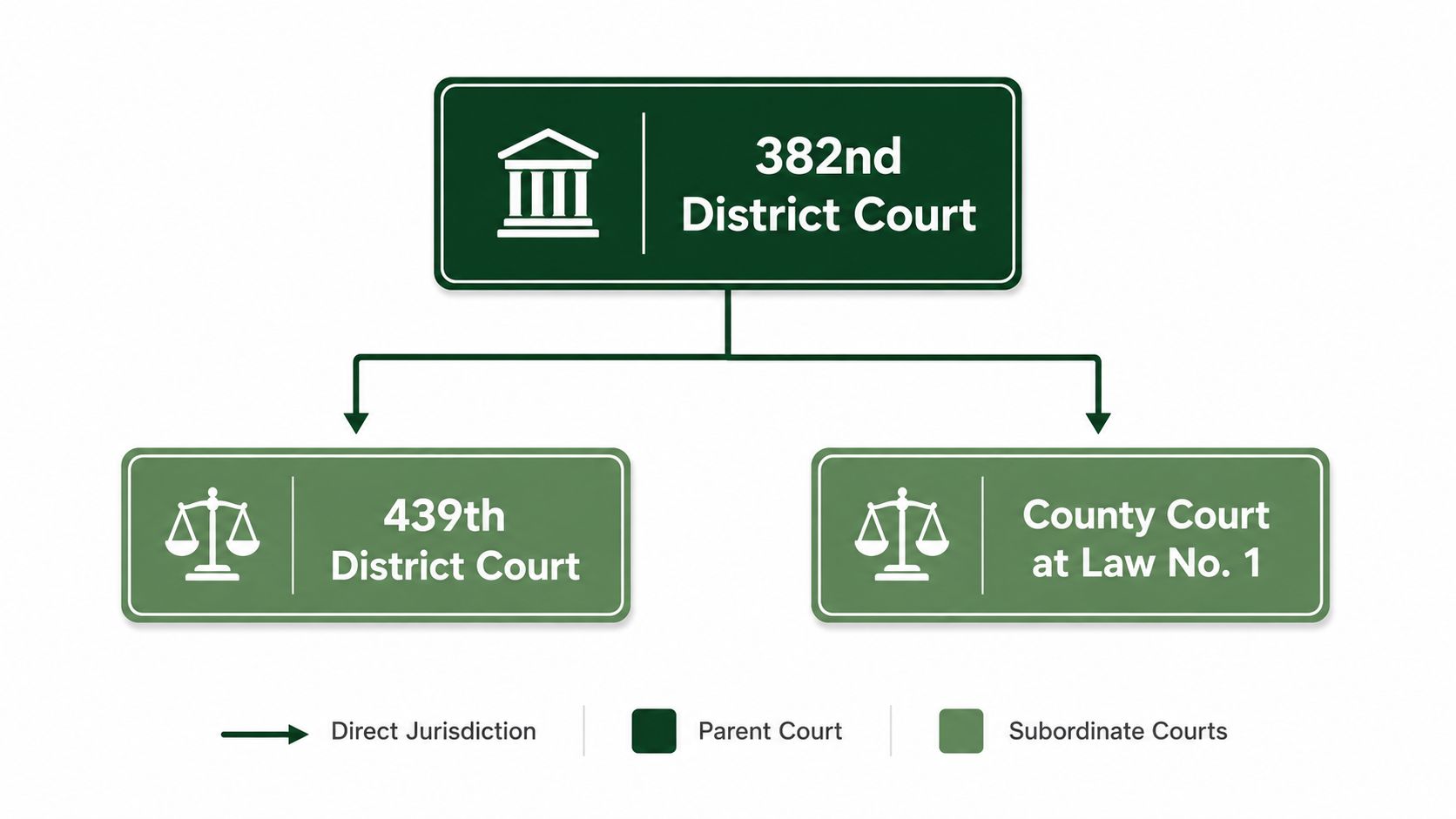
What the shared structure means in practice
A Rockwall County divorce might be filed in one district court, but the way it gets heard depends on the court's shared docket system. Judges can also cover another judge's docket during absences or emergencies under local administrative arrangements, so the court date you see on paper is not always tied to a single courtroom personality or a separate family calendar.
That's good for continuity, but it also means you can't assume a hearing is “just family court” and prepare loosely. You still need to know whether the setting is a full civil docket, a short hearing slot, or a hearing that needs more time because testimony will be taken. The county's structure rewards early preparation and punishes casual assumptions.
For a parent dealing with temporary custody, or a spouse trying to move a divorce toward final hearing, that shared docket structure is the backdrop for every filing and every appearance.
Getting Your Family Matter on the Docket
Rockwall County has made electronic filing the operating norm for represented parties. The county's Civil/Family page states that, as of July 1, 2015, attorneys may no longer file paper documents at the clerk's counter. For day-to-day family practice, that changes everything. A motion doesn't become visible to the court just because it was drafted. It has to be electronically filed, then processed through the clerk's system before it can be used for a hearing setting.
That means timing matters. If you're asking for temporary orders, setting a motion to enforce, or trying to move a divorce toward trial, you need enough lead time for the filing, clerk processing, and docket placement. In a county with a shared civil-family calendar, that is not a clerical detail, it is the gatekeeper for hearing readiness. Rockwall County Civil/Family guidance
The practical filing path
A family-law matter generally moves through a sequence like this:
- File the pleading or motion electronically.
- Let the District Clerk process the filing.
- Confirm the case is ready for a setting.
- Match the request to the right docket slot.
- Verify the hearing information before you appear.
The filing date is only part of the story. The case has to clear the clerk's process before it can truly be treated as ready for a hearing.
Self-represented litigants need to be especially careful here. If you don't have an attorney, you still have to work from the county's electronic filing environment and make sure your request lands in the system the court uses. The District Clerk is also the recordkeeper for district-court proceedings, so record retrieval and docket verification run through that office rather than through a paper walk-in process.
The Sequence of Family Hearings From Temporary Orders to Final Trial
Temporary orders are often the first real turning point in a Rockwall County family case. Texas Family Code Section 105.001 gives the court broad authority to issue temporary orders before a final order, including temporary conservatorship, temporary child support, non-disturbance orders, geographic restrictions, and attorney's fees. In a contested case, that's how the court can stabilize the family's day-to-day reality while the case is still pending. Texas Family Code Section 105.001
In a divorce, temporary relief can go even further. Texas Family Code Section 6.502 allows temporary injunctions and other temporary orders while the suit is pending, including sworn inventories, support payments, document production, attorney's fees, receivership, exclusive occupancy of the residence, and restrictions on spending or other acts. That is why temporary orders hearings are such a big deal in contested Rockwall County divorces. Texas Family Code Section 6.502
How a contested case tends to move
A typical sequence looks like this:
- Temporary orders hearing, where the court addresses immediate custody, support, and safety issues.
- Discovery and information exchange, where the parties gather records and prepare evidence.
- Mediation, if ordered, which is not complete until the parties and their attorneys appear for the entire mediation session.
- Pre-trial settings or status checks, which keep the case moving and help the court see what is ready.
- Final trial, where unresolved issues are decided.
A Rockwall parent seeking more parenting time, or trying to protect a child's routine, usually feels the temporary-orders stage most acutely. Those orders can shape the practical rhythm of the case long before the final decree or final custody order is signed. If you want a deeper look at how custody disputes are usually framed in Texas, the firm's custody FAQ is a useful companion resource.
Understanding Hearing Types and Docket Time Slots
Rockwall County's docket schedule makes one thing clear, not every family matter belongs in the same hearing lane. The county lists a Monday 1:15 p.m. civil docket and Thursday 2:30 p.m. short civil hearings, and family matters can fall into either category depending on what the court needs to hear. A full temporary-orders hearing is very different from a short agreed order or a brief procedural request.
The question is not just “Do I have a hearing?” It's “What kind of hearing is this, and how much time does it need?” A parent asking for temporary custody, for example, usually needs a full setting with evidence and testimony. A motion that only needs brief court action may fit the short hearing slot.
Rockwall County Family Hearing Types and Docket Slots
| Hearing Type | Scheduled Time | Typical Duration | Common Family Matters |
|---|---|---|---|
| Full civil docket setting | Monday 1:15 p.m. | Longer, case-dependent | Temporary orders, contested motions, hearings with testimony |
| Short civil hearing | Thursday 2:30 p.m. | Brief | Agreed orders, procedural matters, uncontested requests |
| Morning docket setting | Monday 8:30 a.m. | Case-dependent | Court call, scheduling, or other docket business |
A hearing can get delayed if the request is placed in the wrong slot. That's why experienced family-law counsel pays close attention to whether a matter is short or whether it needs enough courtroom time to do the job properly. If a motion needs witness testimony, documents, or a judge to resolve disputed facts, a short hearing is usually the wrong place for it.
Common Docket Mistakes and How to Avoid Them
One of the easiest ways to lose time in the 382nd District Court is to file as if paper still controls the process. For attorneys, Rockwall County expects e-filing, and a late or incomplete filing can leave a hearing request sitting outside the docket until the problem is fixed. Rockwall County General Orders and Policies
The next mistake is relying on memory instead of checking the actual setting. Because family matters share civil docket slots, the court cares about the type of hearing, not just the date on your calendar. A short procedural request belongs in a different place than a temporary-orders hearing that will need testimony or exhibits.
Mistakes that slow family cases down
- Using paper filing habits. Attorney-filed documents should go through e-filing.
- Putting every hearing in the same bucket. Match the request to the correct civil or short-hearing slot.
- Arriving unprepared for mediation. If mediation is ordered, the parties and their attorneys need to attend fully and be ready to work.
- Waiting to verify the record. The District Clerk handles docket verification and record retrieval, and both are easier to sort out before the hearing than during it. If you need a quick refresher on common filing and hearing questions, our family law FAQ is a useful starting point.
Judges can also cover one another's dockets, so do not assume a setting will be continued just because the courtroom assignment changes. If you need a continuance, handle it through the proper court process. A missed assumption can leave a family case set, even when everyone hoped it would move.
Practical Next Steps for Your Rockwall County Family Case
If your family case is headed to the 382nd District Court, start with four checks. Confirm which court has your matter, verify the e-filing record, identify the hearing type, and make sure your calendar matches the correct docket slot. Those steps matter whether you live in Rockwall, Heath, Fate, Royse City, McLendon-Chisholm, or anywhere else in the county.
The District Clerk is the right place for district-court record retrieval and docket verification, and the county's public calendar is the best way to confirm whether your matter is set on a civil docket or a short hearing call. If your case involves temporary orders, disputed custody, complex property division, enforcement, or a high-stakes divorce, local representation can save you from procedural mistakes that are hard to unwind.
For a broader overview of family-law services and next-step options, visit the firm's family law practice area. If you're near downtown Rockwall, the local office at 908 N. Goliad Street is close enough to make courthouse planning and client meetings straightforward.
If your case is headed into the Rockwall County family docket, the Law Office of Bryan Fagan, PLLC can help you understand the hearing process, prepare the right filings, and approach the 382nd District Court with a clear plan. Visit The Law Office of Bryan Fagan, PLLC to connect with a local team that handles Texas family law matters in Rockwall County and can talk through your next step.