
You've received a scheduling order in your Rockwall County divorce or custody case, and the final trial date is getting closer. You may be wondering whether mediation is optional, whether you can attend remotely, and what happens if you don't settle. In many Rockwall County family cases, mediation is a required pretrial step, and the local rule is unusually specific: mediation generally must be completed in person before it counts as finished.
That requirement matters in Rockwall, Heath, Fate, Royse City, McLendon-Chisholm, and other county communities because the court handling your case controls the scheduling order and settlement process. The city on your mailing address doesn't determine which court has authority, especially in communities such as Rowlett and Royse City that cross county lines. Your case may be administered through one of Rockwall County's district courts or another local court structure, so read the actual orders filed in your case rather than relying on general assumptions.
Table of Contents
- What Mediation Means in a Rockwall County Family Case
- Where Mediation Before Final Trial Comes From in Texas
- How Rockwall County Courts Handle Mediation
- When Mediation Must Happen in the Pretrial Process
- Exceptions and Special Considerations for Families
- How to Request Mediation or Complete It in Rockwall County
- Practical Preparation Tips Before Your Mediation Session
What Mediation Means in a Rockwall County Family Case
Mediation is a settlement conference led by a neutral mediator. The mediator doesn't act like a judge, decide who is right, or enter orders. Instead, the mediator helps spouses, parents, and other family-law litigants identify disputes, evaluate options, and negotiate terms that may resolve the case before a final trial.
A Rockwall County divorce mediation may address conservatorship, possession and visitation, child support, spousal maintenance, community property, retirement accounts, reimbursement claims, and debt allocation. A custody mediation may focus on the parenting schedule, holiday periods, transportation, school decisions, medical care, and communication between parents. The mediator may meet with everyone together, then speak privately with each side in separate rooms or private sessions.
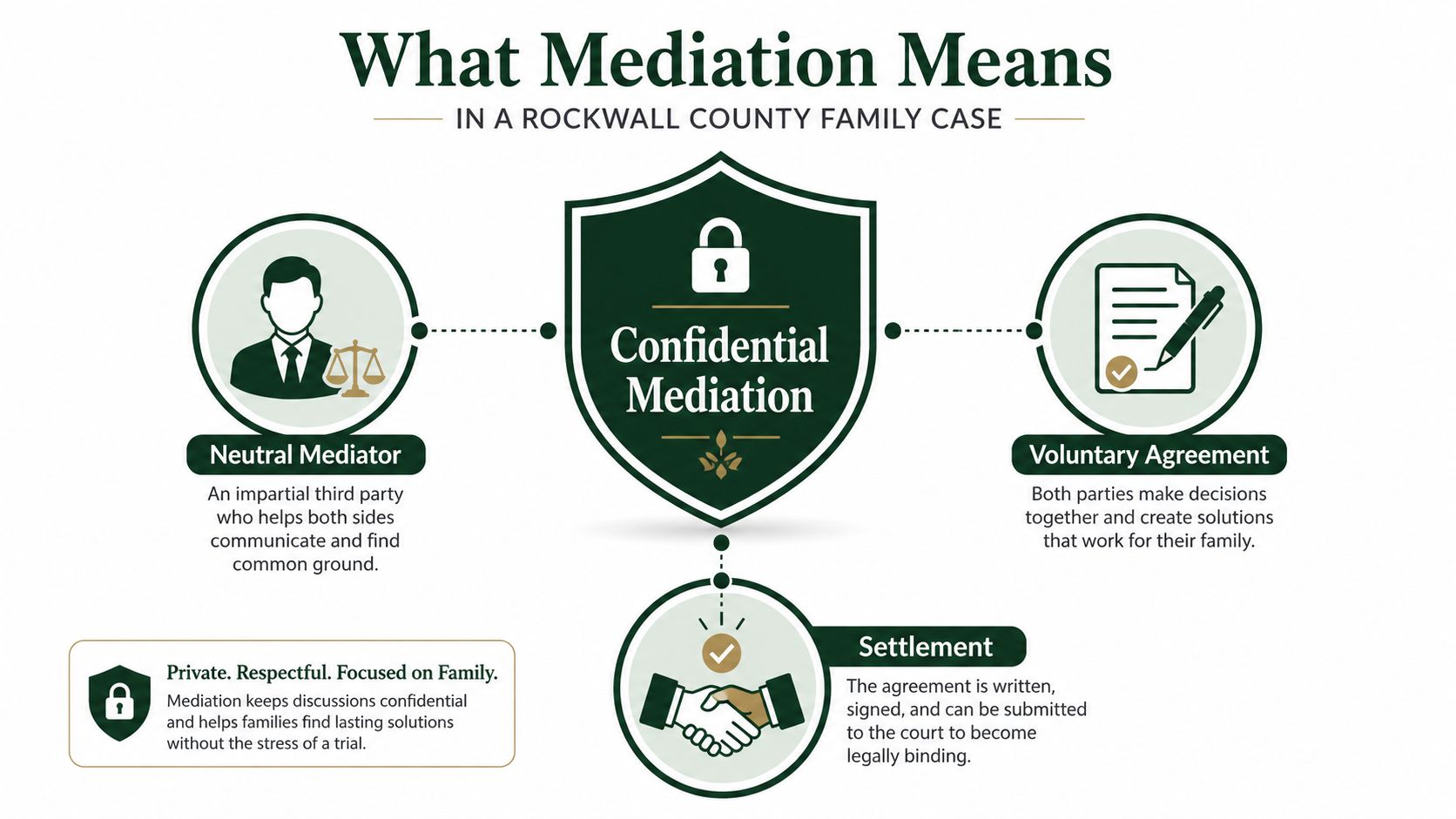
Why the mediator's role matters
Suppose two parents disagree about a 50/50 possession schedule. One parent wants exchanges at school, while the other wants exchanges at a public location. They also disagree about holidays, summer travel, and who handles transportation. A mediator can help them work through each issue, but the mediator can't impose a parenting plan.
Mediation discussions are generally treated as confidential under Texas alternative-dispute-resolution law. That confidentiality gives the parties room to discuss possible compromises without turning every tentative proposal into trial evidence. Confidentiality has limits and exceptions, so your attorney should explain what can and can't be used later in your specific case.
Practical rule: A mediation proposal isn't the same thing as a final agreement. Don't assume you've settled until the written agreement is properly signed and reviewed.
If the parties reach a complete agreement, the mediator or attorneys prepare a written settlement document. In a parent-child case, Texas Family Code section 153.0071 gives qualifying mediated settlement agreements significant legal force, including the possibility of obtaining judgment on the agreement. The signed agreement can then be presented to the appropriate Rockwall County court, including the 382nd District Court or 439th District Court, for entry of final orders.
A partial settlement can still help. If the parties resolve possession but not property division, the unresolved issues can be narrowed for trial. That preparation may reduce the number of disputes the judge must decide, although the case doesn't end unless every required issue is resolved or otherwise addressed by the court.
Where Mediation Before Final Trial Comes From in Texas
Texas law gives courts broad authority to use mediation and other forms of alternative dispute resolution. The statewide framework doesn't make every family case identical, however. The court's order, the type of lawsuit, the issues involved, and local procedures all affect how mediation operates.
Texas Family Code section 6.602 authorizes mediation in suits for dissolution of marriage. For parent-child cases, section 153.0071 addresses mediation and gives qualifying mediated settlement agreements binding legal effect. The statute also creates a process for objecting to mediation based on family violence before the final mediation order. You can review the marriage-dissolution provision through the Texas Family Code mediation authority under section 6.602 and the parent-child mediation statute through Texas Family Code section 153.0071.
Texas courts also use broader alternative-dispute-resolution authority. The relevant framework permits referral of disputed matters to mediation and supports court-managed settlement efforts. In practice, statewide law supplies the authority, while local courts apply it through scheduling orders, mediation orders, pretrial settings, and trial-readiness requirements.
The main authorities at a glance
| Authority | What It Covers |
|---|---|
| Texas Family Code section 6.602 | Mediation in suits for dissolution of marriage |
| Texas Family Code section 153.0071 | Mediation and mediated settlement agreements in suits affecting the parent-child relationship |
| Texas alternative-dispute-resolution framework | Court referral to mediation and other settlement procedures |
| Rockwall County general orders and policies | Local attendance and completion requirements, including the in-person rule |
A published Texas local rule illustrates how mediation can become a gateway to a final trial setting. That rule requires good-faith mediation in certain contested custody and property cases, and it requires a signed statement identifying unresolved issues if mediation doesn't settle everything. The Texas local rules preview shows why parties should treat mediation as part of case management, not as an informal conversation arranged at the last minute.
Rockwall County's policy makes the requirement concrete. The county's general orders and policies state that when mediation is ordered, the parties and their attorneys must appear in person for the entire mediation unless the court specifically permits telephone participation. Mediation isn't considered complete until the parties and lawyers appear for the full session.
How Rockwall County Courts Handle Mediation
Rockwall County's local structure matters because family cases aren't managed through one generic statewide docket. The 382nd District Court and 439th District Court identify family-law matters within their caseloads, and local administrative arrangements distribute Texas Family Code matters among the district courts and County Court at Law No. 1. Juvenile matters are handled through County Court at Law No. 2 under the local rules preview.
For a Rockwall County divorce, custody modification, enforcement case, paternity dispute, or property case, check the style and cause number on your filings. The assigned court's order controls the mediation instructions in your case. The 382nd District Court family docket procedures can help you identify local court information, but they don't replace the scheduling order or a specific mediation order signed in your case.
The in-person requirement
Rockwall County's general policy requires the parties and their attorneys to appear in person for the entire mediation when the court orders mediation. Telephone participation isn't allowed unless the court specifically permits it. A remote conversation, a partial appearance, or an early departure may not satisfy the order.
That means you should plan mediation like a live court appearance. Arrange transportation, childcare, time away from work, and access to the financial and parenting records your attorney may need. If illness, distance, disability, safety concerns, or another serious issue makes attendance difficult, raise it with your attorney promptly. Don't assume that a video conference is acceptable just because remote mediation is common in other settings.
A typical process may include:
- Court referral. The judge or scheduling order directs the parties to complete mediation before final trial.
- Mediator selection. The parties may agree on a qualified mediator, subject to the court's order and applicable law.
- Preparation. Each side organizes financial records, proposed parenting terms, evidence, and settlement priorities.
- Full session. The parties and attorneys attend the entire in-person mediation unless the court authorizes another arrangement.
- Outcome documentation. The mediator or attorneys document whether the case settled fully, settled in part, or remains disputed.
The exact selection process, fees, reporting procedure, and filing requirements depend on the order and the mediator's instructions. Texas mediator qualifications are governed by the applicable alternative-dispute-resolution laws and rules. Don't rely on an online list without confirming that the mediator is acceptable for your court and case.
Failure to attend can create procedural and financial problems. The court may address noncompliance through orders concerning costs or other remedies, but the result depends on the circumstances and the language of the order. If you can't attend or can't pay a required fee, ask for relief before the mediation date instead of just failing to appear.
When Mediation Must Happen in the Pretrial Process
The short answer is practical: if Rockwall County orders mediation before final trial, complete it before treating the case as trial-ready. A contested divorce involving property division, or a suit affecting the parent-child relationship involving custody, possession, or support, may be subject to a mediation requirement before the court proceeds to final trial.
Texas law authorizes mediation, while local procedures connect mediation to trial management. Some Texas county rules require good-faith mediation before a final hearing is scheduled in contested custody or property cases that require more than two hours of court time. If mediation doesn't resolve every issue, the parties may also have to identify the unresolved issues in a signed filing before trial. That kind of rule narrows the dispute and gives the judge a clearer picture of what still needs to be decided.
Read the scheduling order, not a general timeline
Your order may give a specific mediation deadline, identify a pretrial conference, or require completion before a docket call. The date may be earlier than you expect. A court may also modify the schedule when the case involves emergency issues, discovery disputes, family violence allegations, CPS involvement, or another circumstance requiring special handling.
Don't assume that a final trial setting automatically means mediation has already been completed. Ask your attorney or the district clerk's office which orders appear in the file, then compare the mediation deadline with the trial date.
What happens if you miss the deadline
A missed mediation deadline can affect more than settlement discussions. Depending on the order and the reason for noncompliance, the court may deny a requested continuance, assess costs, or take another procedural step. You shouldn't assume the judge will move the trial just because the parties haven't reached an agreement.
A useful calendar should include:
- Mediation deadline: The date by which the session must be completed.
- Trial preparation dates: Discovery, exhibit, witness, and proposed-order deadlines stated in your orders.
- Attendance logistics: Travel, childcare, work coverage, and document access.
- Attorney review time: Time to evaluate offers and prepare a counterproposal.
- Safety or accessibility requests: Any request for separate rooms, protective arrangements, or a different format.
Mediation doesn't guarantee settlement. It does give the parties a structured opportunity to resolve disputes before the judge decides them. If settlement fails, prepare for trial while negotiating. Waiting to prepare because you hope mediation will succeed can leave you exposed if the case remains contested.
Exceptions and Special Considerations for Families
Mediation is not appropriate in every situation, and a court may need to address safety before referring a case. Texas Family Code section 153.0071 allows a party to object before referral when another party committed family violence against the objecting party or the child. If the objection is filed, the court must address it through the statutory process before referring the case.
That protection matters in custody, visitation, child-support, and parental-rights disputes involving coercion, threats, assault, or a protective order. A parent shouldn't feel forced into a negotiation setting that creates an immediate safety risk. Tell your attorney about family violence directly, provide available documentation, and ask how the objection process applies to your case.
Situations requiring careful court review
A pending CPS matter, an active protective order, an emergency request involving alleged abuse, or a serious question about a party's ability to negotiate may require a different approach. The court may postpone mediation, use separate rooms, require attorney involvement, or handle urgent relief through a hearing rather than a settlement session.
The correct response depends on the facts and the relief requested. A temporary-orders issue may be addressed differently from a final custody trial. An enforcement motion may not follow the same path as an original divorce or parentage case.
| Scenario | Typical Court Response | What to File |
|---|---|---|
| Family-violence objection | Court reviews the objection before referral | Written objection and supporting evidence |
| Protective-order concern | Court may consider safety arrangements or a different process | Relevant protective-order records and a request for safeguards |
| Emergency child-safety request | Court may address immediate relief through a hearing | Emergency motion and supporting declarations or evidence |
| CPS involvement | Court may coordinate the family-law process with safety concerns | Relevant CPS documents and a request for appropriate handling |
| Capacity or communication concern | Court may require accommodations or another dispute-resolution format | Motion explaining the concern and requested accommodation |
Don't confuse a standing order with a mediation order. A standing order may restrict conduct during a divorce, but it doesn't necessarily answer whether, when, or how your mediation must occur. Review the Rockwall County standing order in a divorce alongside the scheduling and mediation orders filed in your case.
How to Request Mediation or Complete It in Rockwall County
Start with the documents already filed. Look for a scheduling order, mediation order, docket-control order, or pretrial order. The document should indicate whether mediation is required, when it must occur, how the mediator will be selected, and what must be filed afterward.
If the court hasn't ordered mediation, a party may ask for referral through a motion or a request for relief in a pretrial filing. The request generally identifies the case, explains why mediation may help, and includes a proposed order for the judge's consideration. Whether the court grants the request depends on the case, the timing, objections, and any safety concerns.
A practical request-and-completion sequence
- Confirm the assigned court. Check whether your family case is pending in the 382nd District Court, 439th District Court, or another court identified in the file.
- Review existing orders. Find the mediation deadline and any attendance or mediator-selection instructions.
- Discuss mediator selection. The parties may agree on a qualified neutral, or the court may provide another selection method.
- Address objections early. Raise family violence, accessibility, travel, language, or financial concerns before the session.
- Schedule the full session. Because Rockwall County's policy requires in-person attendance when mediation is ordered, reserve enough time for the entire session.
- Document the result. Ask your attorney or mediator what report or agreement must be filed and who is responsible for filing it.
A settlement document needs careful review. In a parent-child case, the agreement should be evaluated for compliance with Texas Family Code section 153.0071 before anyone signs. A mediated settlement agreement may address custody, possession, support, and other terms, but unclear language can create future enforcement disputes.
Filing and service procedures can change with court instructions and electronic filing requirements. Use the Rockwall County District Clerk e-filing requirements for a family case as a starting point, then confirm the current requirements with the clerk or your attorney. Keep copies of the signed agreement, filed report, and final orders in a secure location.
Practical Preparation Tips Before Your Mediation Session
Treat mediation as a negotiation with legal consequences, not as an informal meeting. Good preparation helps you distinguish between a goal, a legal position, and a concession you can safely make.
Prepare the substance
Write down every issue that could remain for final trial. In a custody case, include conservatorship, possession, transportation, school decisions, medical and dental decisions, communication, travel, and geographic restrictions. In a divorce, add property characterization, the house, retirement accounts, business interests, debts, reimbursement claims, spousal maintenance, and tax-related concerns.
Then divide your list into three categories:
- Must resolve: Terms you can't accept without further legal advice.
- Negotiable: Terms where you have room to trade one benefit for another.
- Information needed: Issues that can't be evaluated until you receive records or clarification.
For example, a parent may care most about school-night stability and reliable exchanges, while remaining flexible about some holiday rotations. A spouse may prioritize keeping the home but need to analyze debt, equity, retirement assets, and the overall property division before accepting that trade.
Organize the paperwork
Bring or securely provide the records your attorney requests. Useful materials may include:
- Financial records: Your current Sworn Inventory and Appraisement, recent pay information, bank records, account statements, loan information, and other documents relevant to property and support.
- Tax information: The tax returns your attorney identifies as necessary for evaluating income, deductions, property, or support.
- Court records: The latest mediation order, scheduling order, temporary orders, protective orders, and prior final orders.
- Parenting materials: A proposed Parenting Plan, school calendars, activity schedules, travel information, and a written description of transportation concerns.
- Evidence summary: A concise timeline of major events, rather than a disorganized stack of messages or photographs.
Don't hide unfavorable facts from your attorney. A surprise at mediation is harder to manage than a problem identified during preparation.
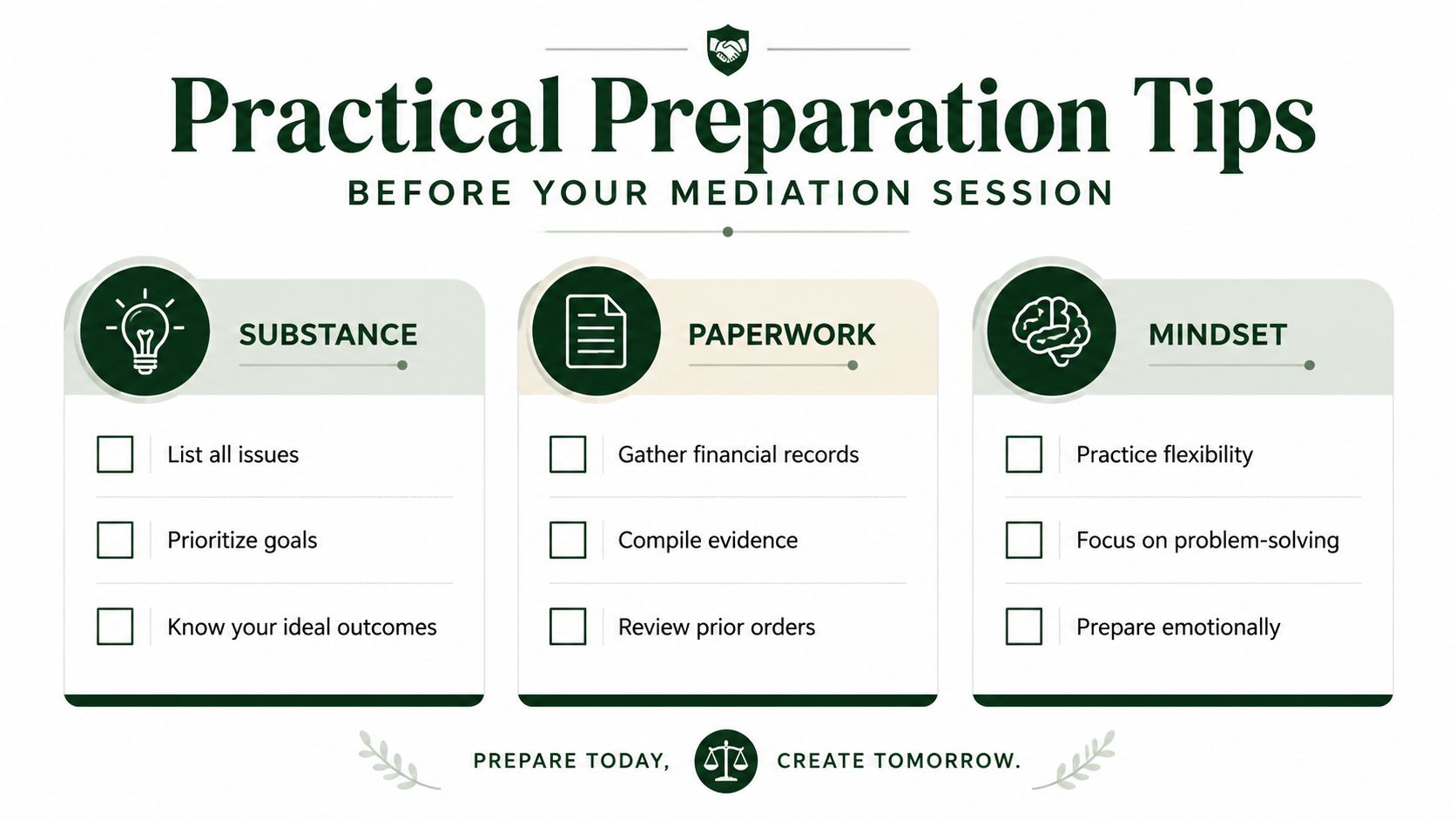
Prepare yourself for the day
Plan for a long in-person session at the mediator's Rockwall-area office. Eat beforehand, arrange childcare, bring necessary medication, and arrive early enough to review the opening proposal without feeling rushed. Ask your attorney whether you should exchange a settlement proposal in advance and whether the mediator wants a pre-mediation memorandum.
Before negotiations begin, decide which routine concessions you can make without stopping for private legal advice every time. Don't give your attorney permission to accept a final agreement without your informed approval, however. Your lawyer can negotiate within the limits you set, but you decide whether to settle.
The Law Office of Bryan Fagan, PLLC offers family-law representation and mediation-related support for Rockwall County divorce, custody, support, modification, enforcement, and other disputes. To discuss how the in-person mediation rule may apply to your case, visit The Law Office of Bryan Fagan, PLLC and request a consultation focused on your court orders, deadlines, and settlement options.