
You've just filed for divorce in Rockwall County, or you've been handed papers by your spouse. You're sitting in your car near the Rockwall County Courthouse, thinking about tonight's bills, the children's school schedule, the joint bank account, and whether you're still allowed to make ordinary decisions.
The short answer is that the Rockwall County standing order in a divorce what it restricts is an automatic set of court rules designed to preserve children, property, insurance, records, and the existing household situation while the case is pending. It limits destructive or unilateral actions, but it usually doesn't freeze normal life. The exact wording controls, so Rockwall residents should verify the current order through the county's official materials rather than rely on a generic Texas summary.
Table of Contents
- What the Standing Order Does the Moment You File in Rockwall County
- How the Rockwall County Family Law Standing Order Applies and What It Covers
- What the Standing Order Restricts on Children, Property, Money, and Conduct
- Everyday Life in Rockwall County That the Standing Order Usually Leaves Alone
- How the Standing Order Differs From Protective Orders and Temporary Orders
- What Happens If the Standing Order Is Violated in a Rockwall Divorce
- Common Mistakes Rockwall County Spouses Make After the Order Takes Effect
- Practical Next Steps for Rockwall County Readers Facing a Divorce Filing
What the Standing Order Does the Moment You File in Rockwall County
A spouse filing for divorce in Rockwall County may leave the courthouse wondering whether the rules begin after service, a hearing, or a judge's personal review. The family-law standing order takes effect when the case is filed. It operates as an automatic temporary restraining order, and TexasLawHelp explains how standing orders remain effective until a court modifies or eliminates them.
The filing date therefore matters. The order is not optional paperwork that either spouse may ignore until signing. It creates court-ordered boundaries intended to protect children, property, accounts, insurance, records, and the household's existing arrangements while temporary issues remain unresolved.
What the filing changes immediately
Suppose one spouse files in Rockwall while the other remains at the family home in Heath. Filing does not decide who receives the home, who has primary possession of the children, or who ultimately gets a particular account. Those decisions require an agreement or a later court order. In the meantime, the standing order works like a guardrail around major decisions.
It generally preserves the status quo in divorce and SAPCR matters and is intended to prevent either spouse from dissipating marital property before the court can address temporary arrangements. The local notice identifies the applicable Rockwall family-law orders and their filing procedure, so the exact wording remains the controlling source.
Practical rule: Filing first, holding a particular account, or remaining in the home does not authorize a spouse to make major unilateral changes because that spouse filed first or controls a particular account.
Ordinary life can continue within those boundaries. Paying regular household expenses, buying routine necessities, taking children to school, and handling ordinary work or parenting responsibilities are different from selling property, draining funds, hiding records, or disrupting established arrangements. The distinction is whether the action preserves normal life or changes the parties' rights and resources before the court rules.
The order follows the case through Rockwall County's family-court process. Depending on the proceeding and assignment, local matters may involve the 382nd District Court, 439th District Court, or Rockwall County Courts at Law. For filing mechanics, the Rockwall County District Clerk divorce filing fee schedule can help locate clerk information, but it does not replace reading the standing order.
How the Rockwall County Family Law Standing Order Applies and What It Covers
A Rockwall spouse can file for divorce in the morning and face binding conduct rules that same day. The local notice identifies standing orders issued by the 382nd and 439th District Courts of Rockwall County, Texas. It states that the applicable version took effect April 17, 2020, replaced earlier versions, and explains how the order accompanies covered filings.
The process is automatic under the local procedure:
- A covered family-law case is filed.
- The applicable standing order takes effect with the filing.
- Both parties must follow its restrictions from that point.
- It remains in effect unless the court changes it or the case ends.
- A temporary order, agreement, or final order can add detail or alter the rules that apply.
The order works like a set of guardrails during the case. It is designed to prevent one party from changing children's circumstances, property, or financial protections before the judge can address those issues.
Filings that can trigger the order
Rockwall's notice addresses initial family-law pleadings and related proceedings involving:
- Divorce cases, including cases involving children or significant marital property.
- Suits Affecting the Parent-Child Relationship, commonly called SAPCR cases.
- Modifications of existing family orders.
- Enforcement and contempt matters involving children or family property.
- Other covered family pleadings identified in the local notice.
The order does not apply to every matter filed in a Rockwall County courtroom. The local notice generally excludes adoptions, enforcement actions of certain types, writs for the return of a child, and cases brought by the Texas Attorney General or the Department of Family and Protective Services. A family with several pending proceedings should check each case separately, because one filing may be covered while another is not.
Why you should verify the current version
Rockwall County keeps separate standing-order and parenting-class materials for district-court and county-court-at-law proceedings. The county's General Orders and Policies page provides the current local materials. Use it instead of relying on a friend's copy or an older online article.
The order binds both parties, not only the spouse who filed. A spouse served later may still be subject to restrictions that began when the case was filed. The local materials also identify when the parent education and family stabilization course requirement is triggered, so confirm the exact court, pleading, and current document before assuming a general Texas rule controls your Rockwall case.
What the Standing Order Restricts on Children, Property, Money, and Conduct
The order's practical purpose is preservation. It addresses conduct that could make a fair final decision harder, including concealment, destruction, relocation, intimidation, or changes to financial protections. Public explanations of Texas standing orders commonly identify restrictions against transferring or destroying property, changing insurance, threatening the other spouse, and interfering with children, as summarized by McClure Law Group's discussion of standing orders.
The safest way to read the order is to compare the prohibited action with the ordinary activity that usually remains available.
The main categories
Children: The order may restrict removing children from the state, changing their circumstances, interfering with the other parent, or making unilateral education or care changes. Continuing an established school, daycare, or medical routine is different from moving a child or changing providers without agreement.
Property: Selling, gifting, hiding, destroying, transferring, or encumbering community or jointly held property can create a problem. That can include real estate, vehicles, household goods, business interests, boats, or recreational equipment. Protecting and maintaining property is different from disposing of it.
Money: Large transfers, unusual withdrawals, new debt, retirement-account changes, or moving funds to conceal them may violate the preservation purpose. Paying ordinary household expenses from an account used for those expenses is generally treated differently, but the exact language matters.
Insurance: Cancelling or changing health, auto, or life insurance can leave a spouse or child unprotected. Paying premiums and maintaining existing coverage is ordinarily consistent with preservation.
Firearms: The order may restrict removing, transferring, concealing, or disposing of firearms when the applicable order language and federal or state restrictions cover them. Firearm issues require careful reading because another protective order may impose additional requirements.
Conduct and records: Threats, harassment, surveillance, intimidation, disparagement in front of children, and destroying or concealing records are the kinds of conduct these orders seek to prevent. Preserving texts, financial records, photographs, and communications is safer than deleting or altering them.
| Category | What Is Prohibited | What Is Still Allowed |
|---|---|---|
| Children | Unilateral relocation, interference, or disruptive changes | Continuing stable routines and cooperating about daily needs |
| Property | Hiding, selling, gifting, destroying, or encumbering shared assets | Protecting, maintaining, and using property for ordinary purposes |
| Money | Unusual transfers, dissipation, concealment, or major new obligations | Ordinary living expenses and regular household payments |
| Insurance | Cancelling coverage or changing protected beneficiaries without authority | Keeping existing policies active and paying premiums |
| Conduct | Threats, harassment, surveillance, and record destruction | Civil communication focused on children and case logistics |
A restriction doesn't automatically mean the other spouse owns the asset or has custody. It means the parties should avoid changing the situation in a way that prevents the court from evaluating it fairly.
Everyday Life in Rockwall County That the Standing Order Usually Leaves Alone
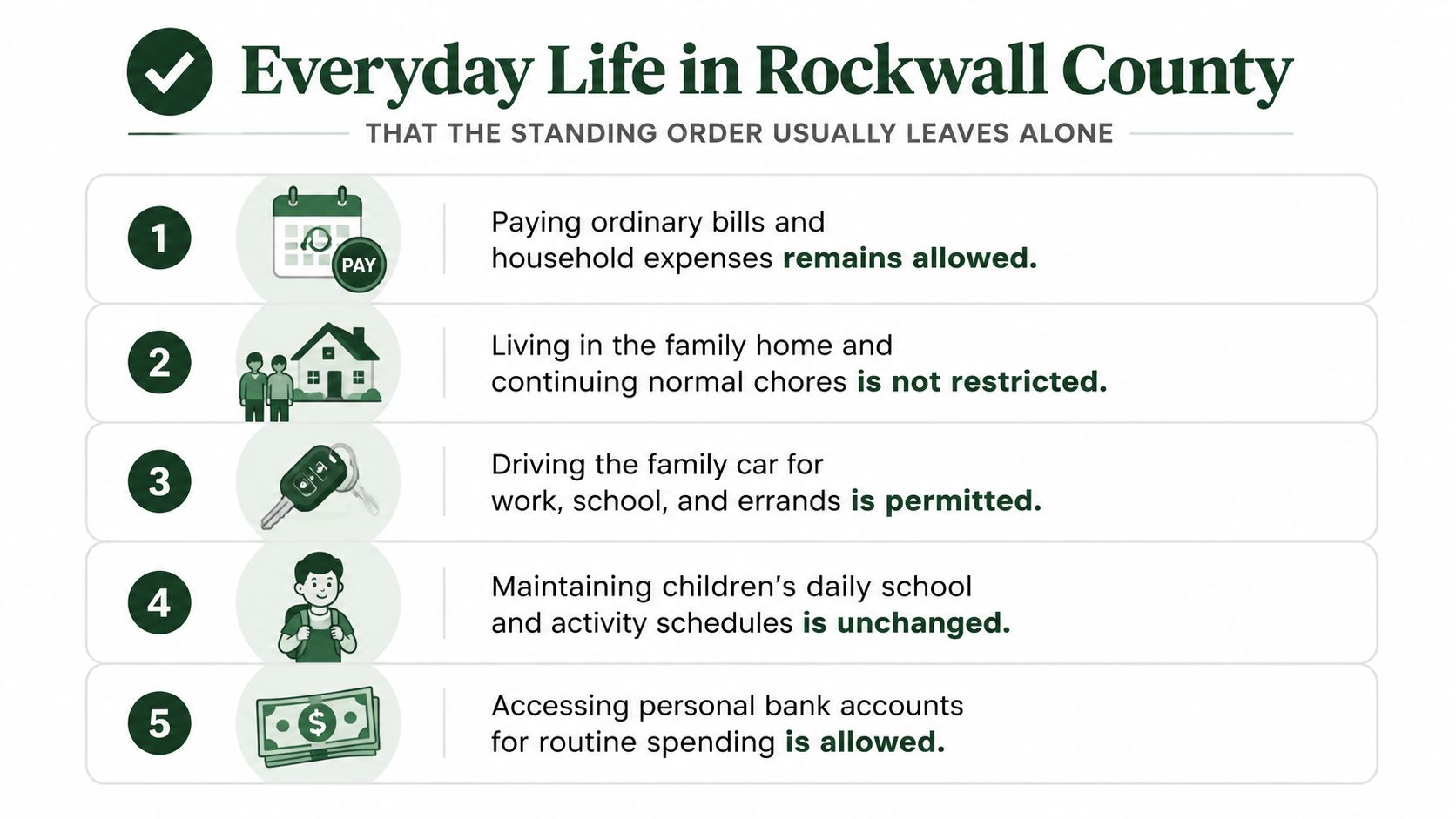
A standing order isn't intended to make a Rockwall household stop functioning. A family can usually continue paying regular utilities, mortgage installments, groceries, and routine vehicle costs. It can also generally continue ordinary medical care for children with their established pediatrician or dentist, provided no one uses those routine decisions to conceal a relocation or block the other parent.
School pickup and daycare drop-off can continue under the existing arrangement when both parents cooperate. A parent in Royse City may still take a child to school, attend an appointment, or handle an established activity. The concern is unilateral interference, not the ordinary logistics that keep children's lives stable.
Ordinary spending is different from asset dissipation
A joint checking account used for regular household bills isn't automatically frozen. Routine spending from that account may continue when it matches the family's established pattern. The risk increases when someone moves substantial funds, opens unusual debt, changes beneficiaries, or shifts money into a new account to keep it away from the other spouse.
Short travel can also be different from relocation. A brief vacation that both parents agree to in writing may fit within ordinary family life. Taking the children out of Texas, refusing to disclose where they are, or making a permanent move without the required consent or court authority raises a separate issue.
The order restricts destructive conduct, not every parenting decision or household errand.
Living in the family home, driving a family vehicle for work or school, buying food, and paying regular expenses generally aren't the same as selling the home, transferring the vehicle, or emptying an account. If an expense is unusually large, a purchase involves shared property, or the parents disagree about travel or school, get advice before acting.
How the Standing Order Differs From Protective Orders and Temporary Orders
People often use “restraining order” as a broad label for several different documents. In Rockwall County, the document's title, trigger, and wording determine what it does.
A family-law standing order applies because a covered case has been filed. A protective order is different. A protective order under Chapter 85 of the Texas Family Code arises from allegations and evidence involving family violence, and it can identify protected people and impose specific no-contact, geographic, or firearm-related restrictions. The standing order doesn't require an allegation of family violence to apply.
A temporary restraining order or temporary injunction is case-specific. A party requests it through the litigation process, and the court can tailor the restrictions to the facts presented. It may address a concern that the general standing order doesn't address in enough detail.
A SAPCR is a type of family case involving parent-child issues. It may involve standing-order protections, but the case also has its own pleadings, parenting issues, and procedural requirements. Review the actual paperwork rather than assuming the title tells you everything.
| Order Type | Trigger | Scope | Duration |
|---|---|---|---|
| Standing order | Filing of a covered family case | General local restrictions | While the case remains subject to the order |
| Protective order | Family-violence allegations and statutory process | Specific protected people and conduct | As stated in the protective order |
| Temporary restraining order | A party's request for immediate case-specific relief | Narrow, fact-specific restrictions | As stated by the court |
| Temporary orders | A request for temporary decisions during the case | Parenting, support, property, or conduct issues | Until changed or replaced |
The Rockwall County 382nd District Court family docket procedures may help you locate local procedural information, but the order governing your conduct is the order issued or incorporated into your case. When orders overlap, don't guess which one controls. A lawyer should compare them, because the more specific or restrictive provision may govern the immediate issue.
What Happens If the Standing Order Is Violated in a Rockwall Divorce
Assume a spouse in Heath discovers that the other spouse cancelled auto insurance, transferred money from a joint account, and removed a vehicle title from the shared records. The first step isn't usually a new lawsuit. The spouse with the concern generally preserves the evidence and raises the issue in the pending family case.
Useful records can include:
- Bank documents: Statements, transfer confirmations, and account alerts.
- Insurance records: Cancellation notices, policy changes, and payment histories.
- Messages: Texts, emails, and communications about the disputed action.
- Property evidence: Titles, photographs, appraisals, and purchase records.
- Witness information: Names of people who observed the conduct or its effects.
A party may file a motion to enforce or seek contempt in the same family court handling the divorce, such as the 382nd or 439th District Court, depending on the case assignment. The court's response depends on the order's language, the evidence, the seriousness of the conduct, and whether the violation can be corrected.
Possible remedies can include an order restoring access or coverage, attorney's fees, sanctions, or a contempt finding. Contempt can carry coercive consequences, including conditional jail time, but no particular remedy is automatic. A less serious issue may be resolved through a corrective agreement or a warning rather than a contested contempt hearing.
Build a dated record
Write down what happened, when you learned about it, what documents support it, and what harm resulted. Don't exaggerate, delete messages, threaten the other spouse, or attempt to punish the person in return. A short, accurate timeline gives your attorney and the court a clearer way to evaluate the dispute.
Common Mistakes Rockwall County Spouses Make After the Order Takes Effect
Suppose you file for divorce in Rockwall County and, that evening, consider cancelling insurance, moving money, or changing who can enter the home. Each choice may feel practical or protective. The standing order may still restrict it because the case is now pending.
Use the order as a pause button before making unilateral changes:
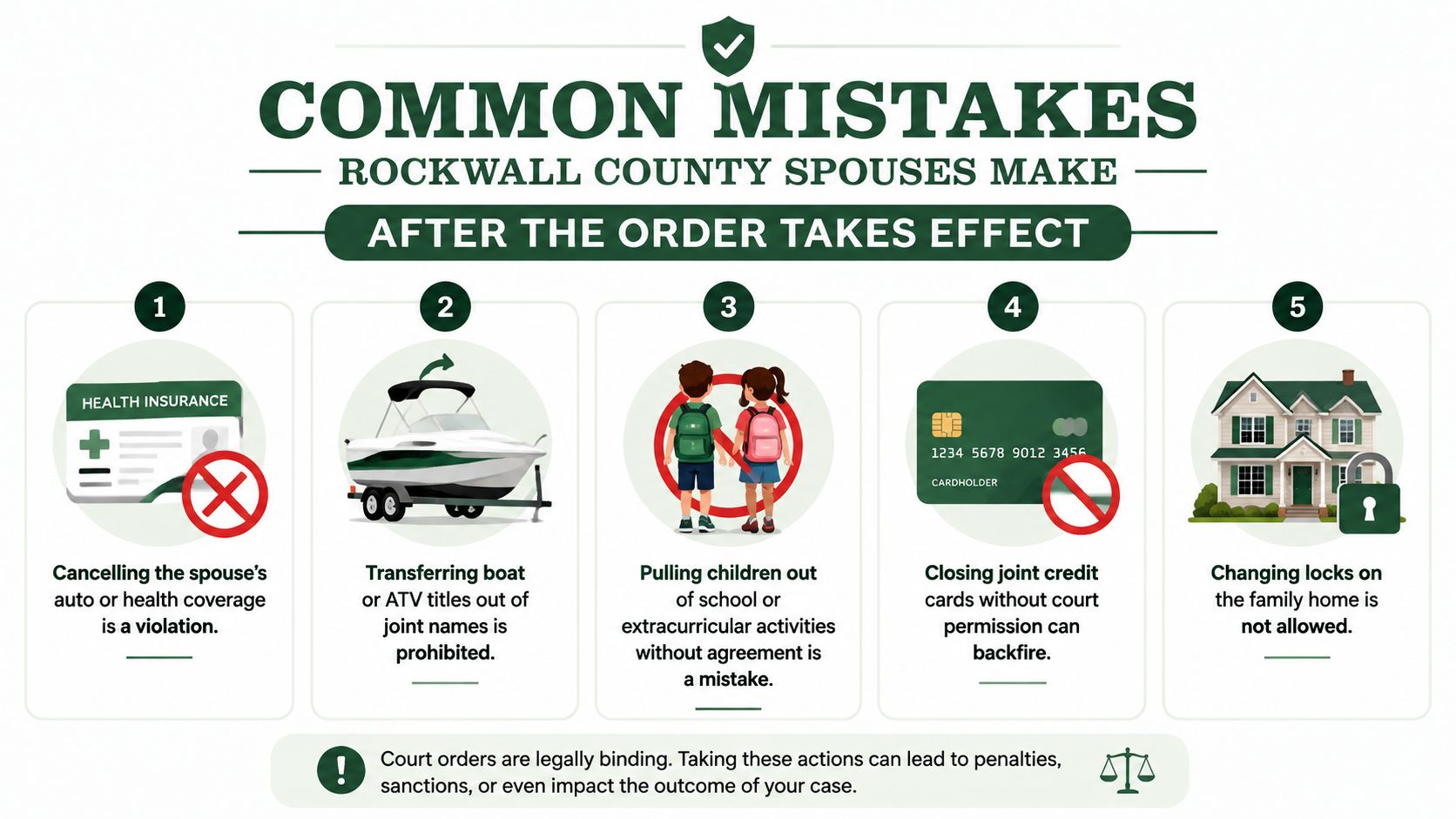
- Keep insurance active: Do not cancel a spouse's or child's health, auto, or life coverage without reviewing the order and obtaining appropriate authority.
- Leave titles alone: Do not transfer a boat, ATV, vehicle, or other jointly connected property out of shared names to gain an unfair advantage.
- Protect the children's routine: Do not pull children from school, daycare, or activities, or change their regular arrangements without agreement or court direction.
- Avoid retaliatory account changes: Do not close joint credit cards, empty accounts, or move money merely to punish or pressure the other spouse.
- Keep home access stable: Changing locks or blocking ordinary access to the family home can create a separate dispute under the order.
- Preserve information: Save financial records, communications, photographs, and account notices. Do not destroy or hide information.
- Use care online: Social-media posts about the divorce, the children, or the other parent can create conduct and evidence problems, even when a post feels harmless.
- Complete the parenting course: Rockwall's related parenting-class order requires a parent education and family stabilization course within 60 days of filing, according to the county's local procedure.
The course requirement is easy to miss because many explanations focus only on prohibited conduct. Rockwall's local layer can require a parent-focused course as part of the filing process. Filing therefore may create an education obligation as well as restrictions on property, money, and conduct.
Ordinary life still continues. A parent can care for the children, pay regular household expenses, communicate about necessary logistics, and preserve the family's routine, subject to the order's exact language. Avoid discussing disputed facts with the children, sending angry messages, or making school and medical decisions solely to limit the other parent's involvement.
If someone faces immediate danger, the standing order may not provide the needed protection. Ask promptly about protective-order or emergency-relief options.
Practical Next Steps for Rockwall County Readers Facing a Divorce Filing
A spouse may receive a divorce filing and assume the standing order is only background paperwork. Treat it as a set of instructions that applies immediately. Read the current order and any related parenting-class order, then compare both with every document served or filed in your case. Confirm whether your case is in district court or county court at law.
A practical first-day checklist
- Identify the case and court. Record the cause number, filing date, court assignment, and case type, such as divorce, SAPCR, modification, or enforcement.
- Read every restriction. Mark provisions concerning children, travel, school, property, accounts, insurance, firearms, communication, and records.
- Calendar the parenting requirement. Rockwall's local procedure requires the parent education and family stabilization course within 60 days of filing when the related order applies.
- Preserve records. Save bank statements, insurance declarations, retirement information, titles, tax records, and important messages in a secure location.
- Maintain stability. Keep children's school, medical, and daily arrangements consistent. Routine care remains possible, subject to the order's exact terms.
- Avoid major changes. Do not sell, transfer, conceal, encumber, or substantially deplete shared property. Do not cancel coverage or change beneficiaries without qualified advice.
- Communicate carefully. Keep written messages civil and focused on logistics. Avoid threats, accusations, or arguments about disputed facts with the children.
- Get advice before signing. A settlement, waiver, property transfer, or parenting agreement can affect rights the standing order does not decide.
For filing questions, review the Rockwall County District Clerk e-filing requirements for family cases. For case-specific guidance, ask a qualified Rockwall family-law attorney to read the current order and assess whether temporary orders, enforcement, relocation relief, protective relief, or another filing fits your situation.
If someone faces immediate danger, seek advice promptly about protective-order or emergency-relief options. The Law Office of Bryan Fagan, PLLC offers family-law guidance for Rockwall County spouses. Bring the standing order, case paperwork, and records showing the conduct or decision you need help evaluating. Visit the Law Office of Bryan Fagan, PLLC to request a consultation.