
The knock usually comes at an ordinary time. A uniformed Rockwall County constable is at the door, the envelope is thick, and the other spouse has finally decided to move the divorce forward the hard way. What happens next is brief, but it matters. Once those papers are handed over, the case clock starts, and the way service is handled can shape everything from your answer deadline to whether the court can finish the divorce at all.
If you've just been served, stay calm and keep the packet together. If you're the one trying to serve, stop treating this as a casual drop-off. In Texas, divorce papers have to be served through a formal, proof-based process, and Rockwall County's constables are one of the most common local options for making that happen. The difference between a clean service and a sloppy one can stall a case for weeks.
Table of Contents
- What Happens When a Constable Hands You Divorce Papers
- Who Can Serve Divorce Papers in Texas and Why Constables Are Common
- How the Constable Serves You
- Your First Week After Service
- Proving Service and the Return of Service
- When the Other Spouse Is Hard to Find
- Turning Service Into a Plan
What Happens When a Constable Hands You Divorce Papers
A Rockwall County constable can complete service without a signature, a chat, or any sign that the person being served wants the papers. Once the citation and petition are delivered correctly, service is complete. That is the point many people miss when the door opens and everything happens fast.
The handoff starts the court deadlines that now control the case.
The packet usually includes the citation, the Original Petition for Divorce, and any other papers filed with the petition. Spread everything out on a table and read it in order. Texas guidance on service explains that divorce papers must be served by a non-party authorized under the rules, including a constable, sheriff, or another person the court or law authorizes (Texas State Law Library divorce service guide).
For Rockwall County residents, that process is local and practical. The county's constable system is part of the ordinary civil service path for cases filed here. If you live in Rockwall, Heath, Fate, Royse City, McLendon-Chisholm, or a nearby community, this may be the first point where your divorce case is handled by a local officer who serves civil papers every day.
The first job after service is simple. Do not argue at the door. Do not throw the packet aside. Read what was filed, then identify your deadline and your next move. If local standing orders may affect your household while the case is pending, review Rockwall County standing orders in a divorce before you act.
Who Can Serve Divorce Papers in Texas and Why Constables Are Common
收到離婚文件的那一刻,真正重要的不是誰敲門,而是送達是否符合法律要求。德州通常要求由案件非當事人、且獲法律或法院授權的人送達,包括治安官、郡警或其他合資格人士。這份正式送達會通知另一方案件已開始,也讓法院日後能確認文件確實交付。相關規則可參考 Texas State Law Library divorce service guide。
在 Rockwall County,郡警常被選用,因為他們已經處理全縣民事文件。縣政府列有四個分區辦公室及電話:Precinct 1,972-204-7210、Precinct 2,972-204-7220、Precinct 3,972-204-7230、Precinct 4,972-204-7240,詳情見 Rockwall County constables page。Precinct 1 也表示,該辦公室送達來自第一司法和平法院及德州各地法院的文件,反映郡警民事送達職責的範圍。
選擇郡警的實際理由很直接:他們熟悉本地道路,能到指定地址查找被送達人,並留下可供法院核對的送達或未送達紀錄。這對住在 Rockwall、Heath、Fate、Royse City 或 McLendon-Chisholm 的申請人尤其有用。若另一方住在有門禁的社區、在其他郡工作,或經常更換住址,送達紀錄會影響接下來如何處理案件。

郡警、治安官或私人送達人都可能負責送達,通常取決於對方居住或工作的郡。完成的 Return of Service 是法院確認送達的主要文件。TexasLawHelp 也說明了這些選項及回執的重要性,詳見 TexasLawHelp divorce service guide。因此,郡警送達常見的原因很清楚:程序正式、地方性強,而且能把查找地址的結果留成法院可核實的紀錄。
How the Constable Serves You
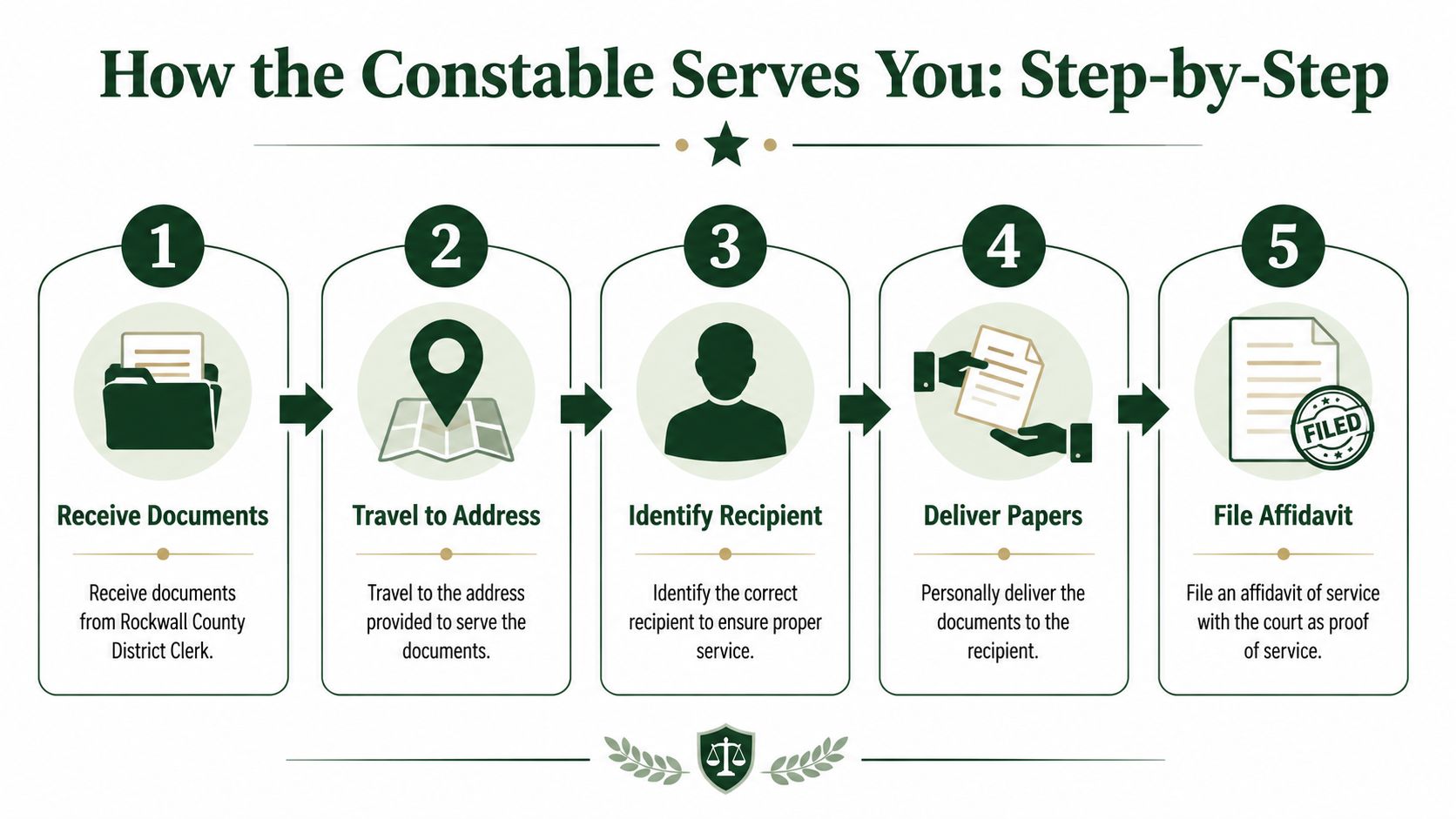
Once the Rockwall County District Clerk issues the papers, the constable receives the citation and petition, travels to the listed address, and looks for the named spouse. If that spouse answers the door, personal service generally means the officer hands the packet directly to them. The officer may identify the case and document the delivery, but the key event is the lawful handoff.
What personal service looks like
If the spouse is not available, the constable may make another attempt, depending on the circumstances and what the court permits. In some situations, the documents may be given to a person of suitable age and discretion at the home, if the law and authorized service method allow substituted delivery. Do not assume that any handoff counts. The method must support a valid Return of Service.
The packet should include the filed papers required for service. If the documents appear incomplete, or a household member accepts them without clear information about what was delivered, check the case file and ask how the constable is recording the attempt. Keep every page and note the date, address, and person who received the papers.
A successful handoff is only one part of the process. The constable's written return must later show the court where, when, and how service occurred.
How that differs from other methods
Certified mail follows a different path. It may cost less, but it depends on the respondent personally signing and returning the green card, as explained in the TexasLawHelp initial divorce papers guide. Posting at the courthouse is limited, and service by publication has stricter rules when children are involved. Neither method gives you the same straightforward record as a constable's documented personal delivery.
If your spouse is easy to locate, constable service often keeps the case moving cleanly through the Rockwall County district courts. If the spouse avoids the door, lives behind controlled access, or has moved to another county, expect more attempts and closer attention to the proof filed with the court.
Your First Week After Service
The constable has handed you divorce papers. Start with the documents, not a phone call or an argument. Read the Original Petition for Divorce and the citation from beginning to end. Record the case number, court number, petitioner's attorney, and every request for temporary orders or other immediate relief.
The first things to mark on your calendar
The citation controls your response deadline. Mark that date at once, then review any request involving temporary orders, the children, support, or use of the family home. If residency requirements affect your case, add those dates to the same calendar.
Use this checklist:
- Read every page: Requests affecting custody, support, and property may appear beyond the opening pages.
- Note the court: Rockwall County divorce matters commonly proceed through district courts and courts at law. Confirm the court named in your papers.
- Calendar the deadline: A missed answer deadline can give the petitioner a path to a default judgment.
- Prepare an Answer or General Denial: File with the Rockwall County District Clerk in person or through eFileTexas.
- Ask about temporary orders early: Custody, child support, possession, and home use may require prompt court action.
Do not wait for the other side to make the next move. If filing fees concern you, review the Rockwall County District Clerk divorce filing fee schedule before delaying your filing. Keep the citation, petition, attachments, and any notes from the constable together so your lawyer can check what was served and what must be answered.

Do not wait to see what happens next. After service, organize the papers, prepare your answer, and ask about temporary orders before the deadline passes without action.
Proving Service and the Return of Service
A constable's knock starts the service process, but the court needs a filed record before it can rely on that service. The Return of Service is that record. TexasLawHelp explains that after personal service, the server completes a return stating when and where the respondent was served, then files it with the court or returns it for filing (TexasLawHelp article on serving the initial divorce papers).
Check the filed return rather than relying on what anyone remembers. It should identify the officer, include a signature and precinct or badge information, and state the date, time, and address of service. It also needs enough detail to show who received the papers and the method used. After the Rockwall County District Clerk files it, the return becomes part of the case record.
Why the filing date controls the default clock
The date the return is filed controls the waiting period for a default divorce. Texas Rule of Civil Procedure 99 requires the Return of Service to remain on file for at least 10 days before the divorce can be completed. The day of filing and the day of court are not counted, according to the Rockwall County constables page summary of Texas law and TexasLawHelp guidance (Rockwall County constables page summary of Texas law and TexasLawHelp guidance).
That makes the filed date more important than the date the citation was issued. Ask for confirmation that the return reached the clerk's file, especially if a constable delivered the papers in Rockwall County but the respondent lives or works elsewhere.
Certified-mail service creates a different record because the signed green card supplies the delivery proof. Posting or publication also requires documentation showing that the method met the court's limited requirements. In every case, the judge needs a reliable paper trail before the divorce can proceed.
When the Other Spouse Is Hard to Find
Each failed attempt adds time and cost to the case. A spouse may change jobs, move without notice, work in another county, or refuse to open the door. A Rockwall County constable can keep trying, but repeated dead ends usually require substituted service or another method approved by the court.
Mixed-county and relocation problems
Rockwall County has a local complication: part of Rowlett lies in Rockwall County, while another part lies in Dallas County. The county where the spouse lives or works can affect which officer has practical authority to serve the papers and where service should occur. Do not rely on the mailing city to identify the correct county.
If personal service fails, the petitioner can ask the court for substituted service after documenting the unsuccessful attempts. Citation by publication may be available in limited circumstances (TexasLawHelp article on how to serve the initial divorce papers). Certified mail under Rule 106 is complete only when the addressee signs for it, making it a poor choice when the spouse is actively avoiding delivery. Publication has narrower requirements, particularly when children are involved.
Service methods when the other spouse is hard to locate
| Service Method | Typical Timeline | Key Requirement |
|---|---|---|
| Constable or sheriff personal service | Depends on how quickly the spouse is found | Physical delivery plus a filed Return of Service |
| Certified mail | Fast only if the card is signed and returned | The respondent must personally sign the receipt |
| Substituted service | Slower, because it usually requires court approval after failed attempts | Proof that direct service did not work |
| Citation by publication | Often the last resort | Limited circumstances, and tighter rules in child-related cases |
Ask the constable's office what information would help locate the respondent, such as a current address, workplace, vehicle description, or reliable schedule. Give the district clerk and your attorney every updated lead, then keep copies of returned citations and attempted-service records.
Do not assume the divorce deadline is advancing while service remains incomplete. Confirm which court must approve the next method and make sure the order describes exactly where and how the papers may be delivered.
Turning Service Into a Plan
A constable visit begins the phase where the divorce requires a structured plan. Once service is complete, act before the next deadline arrives. Decide whether to file an answer, request temporary orders, or seek immediate protection for the home, child support, or a custody arrangement.
What to do next
Start with the documents. Gather pay stubs, tax returns, bank records, and a parenting schedule if children are involved. Confirm which Rockwall County court has your case, because the filing and hearing path depends on where the petition was placed. Before submitting anything, review the local guide to Rockwall County District Clerk e-filing requirements for family cases.
Best next step: answer first, organize second, negotiate third. Waiting to “talk it out” before protecting your deadline can leave you behind procedurally.
Use the Rockwall County District Clerk's records search, local self-help materials, and legal aid options to get oriented. If you are unsure whether the 382nd District Court, another district court, or a court at law will handle the next phase, get that question answered now. The first week after service can determine whether you respond on time and whether temporary relief is available when you need it.
Keep a record of the citation, the date of service, your filing deadline, and every document you submit. If the other spouse lives in another county or remains difficult to locate, coordinate with the clerk and your attorney about the service status and the proof required for the case file. A plan should carry the case from the constable's visit through a filed, verified Return of Service.
The Law Office of Bryan Fagan, PLLC provides family law assistance in Rockwall County involving divorce, custody, support, temporary orders, and property division. If you were served in Rockwall County and want a local review of your next step, visit The Law Office of Bryan Fagan, PLLC to schedule a consultation.