
A parent living near the Rockwall ISD and Royse City ISD line may move only a few streets, enroll a child in the school serving the new address, and believe everything was handled correctly. Then the other parent files an enforcement action, arguing that the move violated a geographic restriction in the custody order. The school accepted the enrollment, but the family court order may still control where the child's primary residence can be maintained.
That's the hidden risk in a Rockwall ISD and Royse City ISD boundary custody dispute. School districts apply enrollment rules, while courts enforce custody orders. You must satisfy both systems. Before signing a lease, buying a home, changing a child's address, or requesting a transfer, read the current order and verify the exact attendance boundary.
Table of Contents
- The Hidden Trap of School Zone Moves in Custody Cases
- How Texas Custody Orders Define Geographic Restrictions
- Navigating School District Boundary Lines and Enrollment Rules
- When a Move Triggers a Custody Modification or Enforcement
- Practical Steps for Parents Facing a Boundary Dispute
- Common Mistakes to Avoid in School Zone and Custody Fights
- Next Steps and When to Consult a Rockwall Family Law Attorney
The Hidden Trap of School Zone Moves in Custody Cases
A parent near Fate or Royse City may learn that a new attendance map assigns the child to another elementary school. The parent finds a home across the boundary, signs a lease, submits residency records, and receives enrollment approval. That approval can create a dangerous false sense of security.
School enrollment and custody enforcement are separate systems. If the order limits the child's primary residence to Rockwall ISD, Royse City ISD, Rockwall County, or another defined area, a move across that line may violate the order even though the district accepts the address. The registrar decides whether the child qualifies for enrollment. The court order decides whether the child's residence complies with the custody arrangement.
Rockwall ISD assigns students to the neighborhood zone where they reside and publishes an attendance-zone map for the 2026–2027 school year. Rockwall ISD's attendance-area information shows why the exact residence matters. The address may affect enrollment rights, transportation eligibility, and the district responsible for the child's placement.
Why a short move can create a major legal problem
A few streets can change more than the child's campus. Review these consequences before signing a lease or changing the child's address:
- Primary residence: The order may restrict where the child lives, regardless of where a parent owns or rents property.
- School continuity: A new address may change the campus, feeder pattern, transportation, or sibling placement.
- Possession schedules: Longer travel can interfere with exchanges and weekday possession.
- Enforcement exposure: The other parent may claim that the move breached a geographic restriction or disrupted the court-ordered arrangement.
Royse City ISD covers roughly 77 square miles across Rockwall, Collin, and Hunt counties. Royse City ISD's public district resources describe district information, including rezoning activity connected to growth and new campuses. The district approved 2024–2025 elementary and middle school boundary zones in December 2023 and later issued rezoning notices for 2025–2026, including changes associated with Paula Walker Elementary opening in August 2024.
Practical rule: School enrollment approval is not permission to relocate under a custody order.
Audit the current order before taking action. Rockwall County parents should also review the Rockwall County standing order and the restrictions it may impose, while recognizing that a standing order and a final custody order serve different purposes. If the geographic language is unclear, obtain legal guidance before the move. Waiting until enforcement papers arrive can limit your options.
How Texas Custody Orders Define Geographic Restrictions
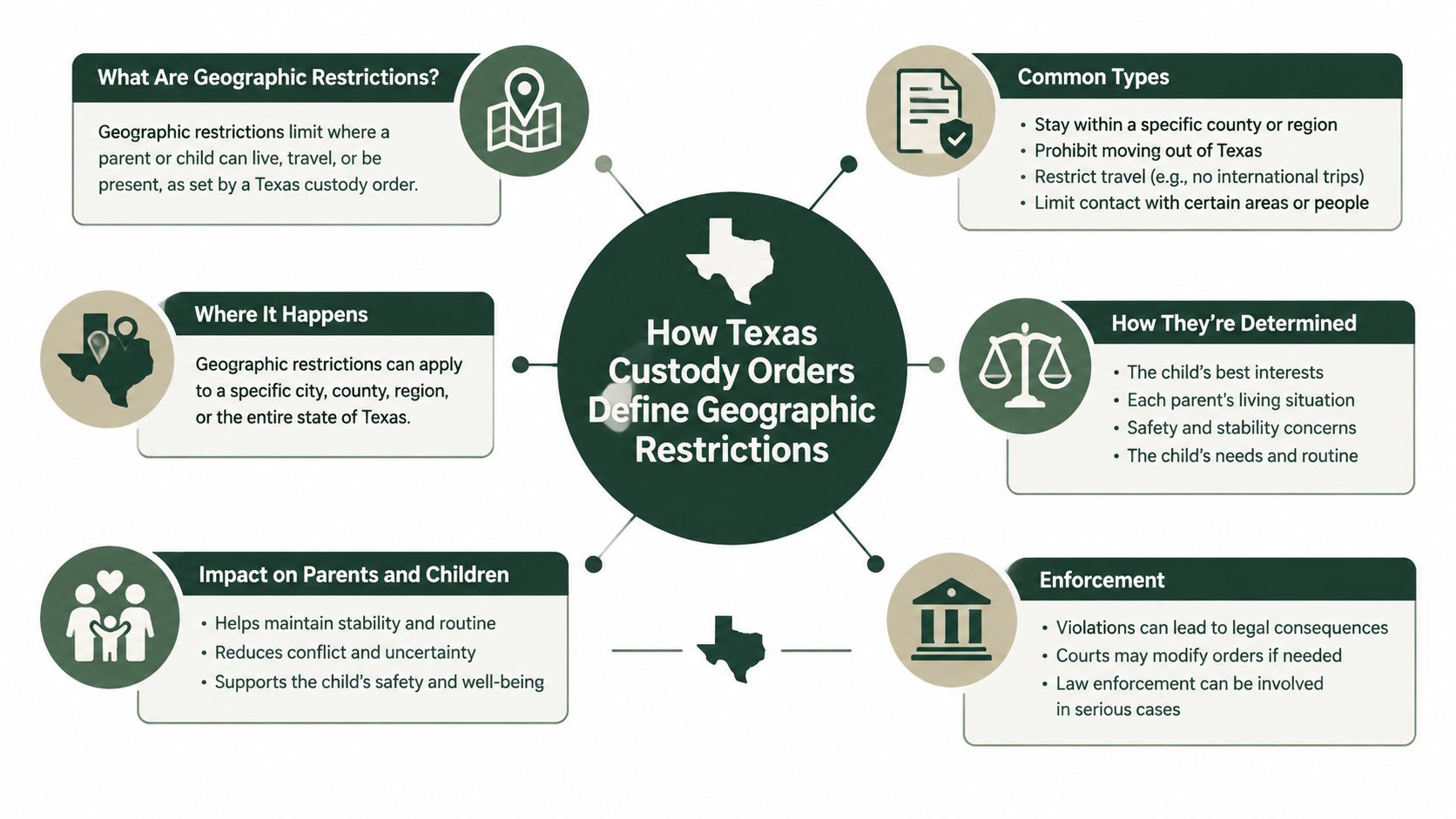
A geographic restriction is a provision in a Texas custody order that limits where a child's primary residence may be maintained. The restriction may identify a county, contiguous counties, a municipality, or a particular school district. Texas family-law guidance recognizes school-district restrictions as a common boundary, and changing the restriction generally requires a Chapter 156 modification unless the parents reach an enforceable agreement. Texas guidance on geographic restrictions in custody orders explains why the existing order remains controlling until a court changes it.
The restriction usually addresses the child's residence, not the parent's personal address. A parent may work, own property, or spend time outside the restricted area, but the key question is where the child's primary residence is maintained under the order.
What language to find in your order
Read the decree, modification order, temporary order, and any later agreed order together. Look for provisions that:
- Name a school district: The child's primary residence may be restricted to Rockwall ISD or Royse City ISD.
- Name a county or counties: The order may permit residence within Rockwall County or within Rockwall County and contiguous counties.
- Define an attendance zone: The order may refer to a specific campus, feeder pattern, or attendance area.
- Limit relocation: The order may prohibit establishing the child's residence outside the listed geographic area.
- Address education separately: A provision may assign decision-making authority over school enrollment without changing the residential restriction.
Those provisions aren't interchangeable. A parent may have authority to participate in educational decisions but lack authority to move the child's primary residence outside the permitted area. Conversely, a child might remain inside the permitted county while a new address falls into a different district, creating a school and possession problem without necessarily creating the same geographic-restriction violation.
Why the 382nd and 439th District Courts matter locally
A Rockwall County custody dispute may be filed in a court with family-law jurisdiction, including the 382nd District Court or 439th District Court, depending on the case and assignment. The Rockwall County District Clerk handles filings for district-court matters, but the correct filing path depends on the existing case, the order being challenged, and the relief requested.
Don't rely on the city name printed in a mailing address. Rockwall ISD covers approximately two-thirds of Rockwall County, shares county boundary lines on the north, west, and south, and has an irregular eastern boundary running through Fate. Rockwall ISD's district description demonstrates why a street-level review is more reliable than a general assumption about a community.
The exact wording controls. A parent shouldn't infer permission from a school map, a conversation with a registrar, or a real-estate listing.
Navigating School District Boundary Lines and Enrollment Rules
A school registrar can approve an address while the same address violates a Texas custody order. That is the hidden trap. Rockwall ISD or Royse City ISD may decide that a child qualifies for enrollment under education rules, but only the family court can determine whether the child's residence complies with the geographic restriction. Enrollment approval does not authorize a prohibited move.
How a boundary residence is evaluated
Texas Education Agency guidance states that a child generally attends the public school district where the child resides. If the residence sits near a district boundary, the applicable school board may decide enrollment eligibility, and a grievance may be available if the residence remains disputed. TEA's school-district-locator guidance explains the district-location process.
A district may request a lease, utility records, or other proof of residency. Those documents establish where the family lives for enrollment purposes. They do not establish that the move complies with the geographic language in a custody order.
Enrollment pressure can create the conflict. A school may deny enrollment, limit a transfer, or direct the family to another attendance area. A parent may then move the child to an address that solves the school problem but falls outside the court-defined area. Complying with district rules does not excuse noncompliance with the order.
| Question | Decision-maker |
|---|---|
| Does the address fall within an attendance area? | The school district under its enrollment rules |
| Does a boundary residence qualify for enrollment? | The applicable school board |
| May the child's primary residence move outside the court-defined area? | The family court under the custody order |
| Does a relocation require a modification? | Determined under the order and applicable Texas law |
Texas admission guidance also recognizes eligibility when a parent living in the district is a joint managing conservator, sole managing conservator, or possessory conservator. A child may also qualify when a guardian or another person with lawful court-ordered control resides there. TEA's public-school admission guidance addresses these enrollment relationships. That guidance concerns school eligibility, not permission to disregard a residential restriction.
The safe sequence
Verify the proposed address and attendance area with the district. Read the custody order before signing a lease, changing the child's address, or submitting enrollment documents. Compare the order's geographic language with the district's determination, including any boundary or transfer decision.
If the school's answer and the order point in different directions, pause the move and seek legal advice. A registrar's approval is not a defense to violating a court order.
When a Move Triggers a Custody Modification or Enforcement
A parent facing a boundary change has two very different choices: seek permission before moving, or move first and defend the decision later. The first path is controlled and document-driven. The second can expose the parent to enforcement litigation, contempt allegations, and an order requiring the child's residence to return to the permitted area.
Proactive modification
A parent who needs to move from a Rockwall ISD area into Royse City ISD, or the reverse, may need a modification under Chapter 156 of the Texas Family Code. The court generally evaluates whether circumstances have materially and substantially changed and whether the requested change serves the child's best interest. The exact requirements depend on the existing order, the requested relief, and the case's facts.
A strong request should address the effects of the move:
- School impact: Explain the proposed campus, attendance area, educational continuity, and transportation plan.
- Possession logistics: Show how exchanges, weekday periods, holidays, and extracurricular activities will work.
- Child-centered reasons: Document work, housing, family support, safety, or educational reasons without overstating them.
- Co-parenting plan: Offer practical arrangements that preserve the other parent's relationship with the child.
- Residency proof: Identify the proposed address and its verified district assignment.
Mediation may help parents reach a written agreement, but an agreement must be properly documented and incorporated into an enforceable order when necessary. A verbal understanding is a poor substitute for court-authorized relief.
Reactive enforcement
If the parent moves without approval, the other parent may file an enforcement action alleging a violation of the order. Depending on the conduct and the order's language, the court may consider contempt, remedies that require compliance, attorney's fees, sanctions, or a return of the child's primary residence. Texas family-law guidance on geographic restrictions emphasizes that a restriction governs the child's primary residence, not merely a parent's address.
Moving first can turn a school-planning problem into a custody-enforcement problem.
If an urgent move is unavoidable, discuss temporary orders or emergency relief with a qualified attorney before changing the child's residence. Parents should also consider a Rockwall County custody evaluation and social-study process when the court needs structured information about the child's circumstances. No process guarantees a result, and the court's decision will depend on the evidence and governing order.
Practical Steps for Parents Facing a Boundary Dispute
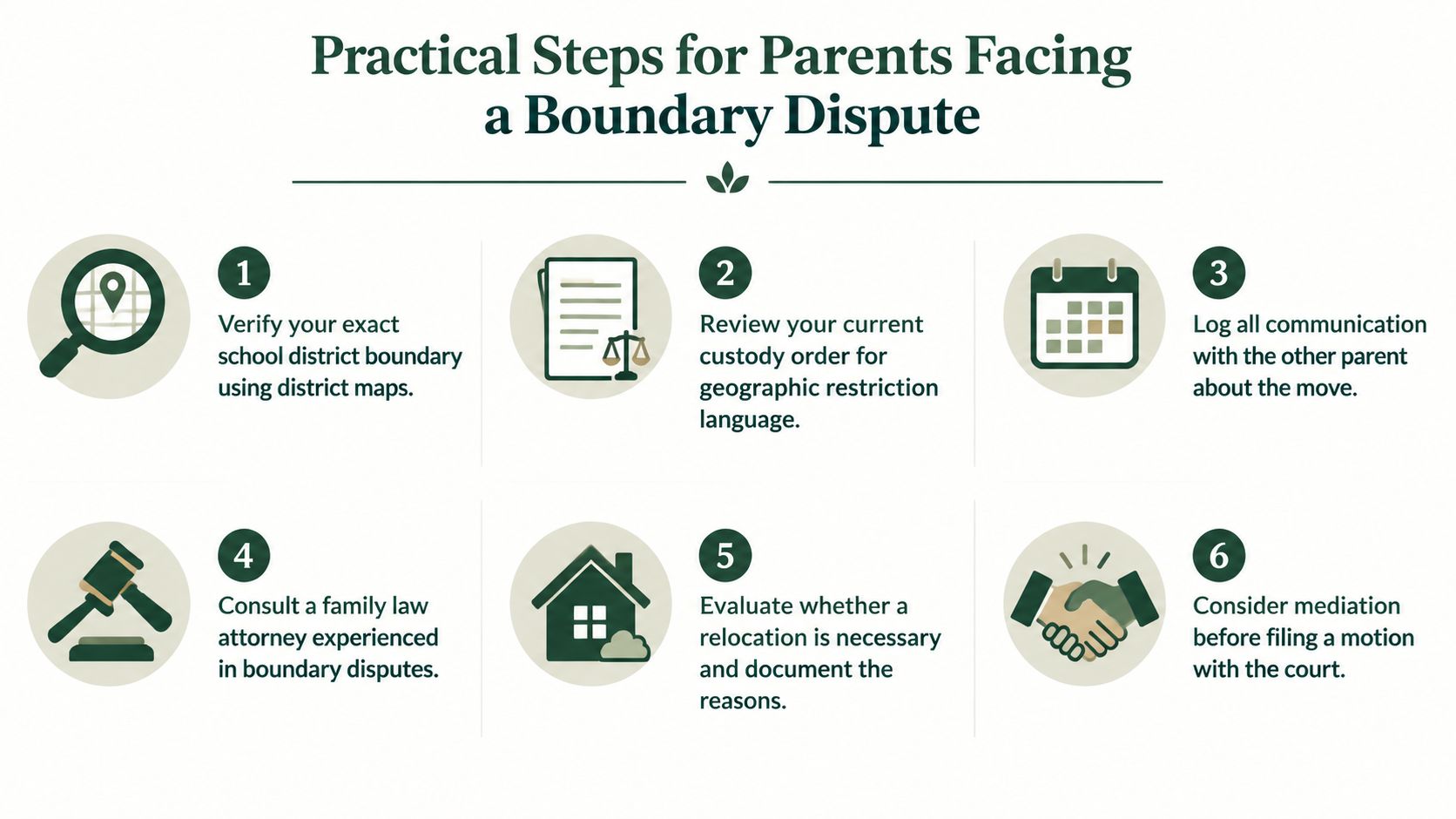
Start with documents, not arguments. A parent who wants to move near the Rockwall and Royse City border should create a complete record before contacting the school or signing a contract.
Build a boundary and order file
Collect the current custody order and every later modification, temporary order, or agreed order. Highlight phrases such as “primary residence,” “geographic restriction,” “school district,” “attendance zone,” and “residence of the child.”
Then verify the address through the district itself. District maps, enrollment staff, and written eligibility decisions are more useful than a listing on Zillow or a statement from a real-estate agent. Save the map version, correspondence, and any board decision connected to the address.
Assemble proof of actual residence
Keep copies of documents that show where the child will live:
- Lease or purchase documents: Preserve the signed agreement and the property address.
- Utility records: Retain service confirmations and statements tied to the residence.
- Parenting records: Organize calendars showing possession, exchanges, and overnights.
- School communications: Save enrollment applications, transfer requests, and district responses.
- Communication history: Keep emails and messages about the proposed move, school, transportation, and consent.
Don't edit messages to make them look cleaner. Preserve the original context and avoid threats, insults, or statements suggesting that the other parent's time will be reduced.

Ask for written consent or court relief
Present the other parent with a specific proposal. Include the address, district, school, move date, transportation plan, possession adjustments, and how the child will maintain contact with both parents. If the other parent agrees, obtain a formal written agreement and determine whether court approval is required.
If there's no agreement, don't enroll the child first and hope the dispute resolves later. A modification request may be appropriate, and temporary orders may address an urgent housing or school issue while the case proceeds. A Rockwall family-law attorney can help organize the evidence and identify whether the issue belongs before a district, a court, or both.
Common Mistakes to Avoid in School Zone and Custody Fights
The most common mistake is treating a mailing city as a legal answer. Royse City and other communities can involve boundaries that cross county lines, so the city printed on an address doesn't by itself establish venue, jurisdiction, school eligibility, or compliance with a custody order.
Rockwall ISD's boundary also isn't identical to every municipal boundary. A home in Fate, Heath, Rockwall, McLendon-Chisholm, or the Rockwall County portion of Rowlett must be evaluated by its actual address and applicable district map, not by the community name alone.
Assumptions that create avoidable risk
- “The registrar approved it, so the court must allow it.” Enrollment approval answers an education question. It doesn't amend a custody order.
- “The other parent said it was fine.” A casual text or verbal conversation may not modify the court's written geographic restriction.
- “The move is too small to matter.” A short distance can cross a district, county, or attendance-zone line.
- “Real-estate listing guarantees the school.” Listings can be outdated or imprecise. Confirm the address directly with the district.
- “My address controls the child's residence.” The order may focus on the child's primary residence, not the parent's separate personal address.
A parent who relies on informal advice may later face an enforcement petition in the 382nd District Court, 439th District Court, or another court with jurisdiction over the case. The Rockwall County Clerk and District Clerk can provide procedural information, but courthouse staff can't interpret the order or advise you whether a move violates it.
Don't ask only, “Can my child enroll there?” Ask, “Does the proposed primary residence comply with the custody order?”
Next Steps and When to Consult a Rockwall Family Law Attorney
Get legal help before acting if the other parent refuses to approve the move, the district's rezoning changes the child's school, or an enforcement petition has already been filed. The urgency increases when the move affects weekday possession, transportation, sibling placement, or the child's primary residence.
Bring the complete order, proposed address, district correspondence, school maps, lease or purchase documents, possession calendar, and communications with the other parent. A lawyer needs the actual language, not a summary. The same phrase can carry different consequences depending on whether the order names Rockwall County, contiguous counties, Rockwall ISD, Royse City ISD, or a specific attendance area.
Rockwall County families should also distinguish local court procedure from school administration. The Rockwall County Courthouse, District Clerk, County Clerk, Courts at Law, and the Fifth Court of Appeals serve different functions. A school-board grievance may address enrollment eligibility, while a modification or enforcement case addresses the custody order. Filing in the wrong place or asking the wrong decision-maker for relief can waste time and increase conflict.
Reviewing the Texas child custody process can help you understand the broader framework, but a boundary dispute requires order-specific analysis. The right question isn't whether Rockwall ISD or Royse City ISD is the better school choice. It's whether the proposed residence, enrollment decision, and possession plan comply with every binding rule.
The Law Office of Bryan Fagan, PLLC offers consultations for Rockwall County parents dealing with custody modifications, enforcement actions, relocation requests, and school-boundary conflicts. Visit The Law Office of Bryan Fagan, PLLC to request help reviewing your custody order before you move, enroll your child, or respond to an enforcement filing.