Mediation in Rockwall County isn't set by one statewide price. Texas county programs can run from $20 per party in some community cases to several hundred dollars per party in court-connected cases, while a local Rockwall private mediator lists $2,000 per party for a full-day session, so you need to confirm the current Rockwall path and fee before you build your budget.
If you're in Rockwall, Heath, Fate, Royse City, McLendon-Chisholm, or another Rockwall County community, you may be reading this after getting a court notice, talking with your lawyer about a divorce, or realizing your custody case probably won't go straight to trial. That moment catches a lot of families off guard. They expect to budget for filing fees and attorney's fees, but not for mediation.
In family law, that surprise matters because mediation often isn't just an optional add-on. In Rockwall County, it can be a normal step in divorce, child custody, support, modification, enforcement, temporary orders, and property division disputes. The practical question isn't just "How much does mediation cost?" It's also "Which kind of mediation am I being sent to, who pays it, and when is the money due?"
Table of Contents
- What Rockwall Families Search For When They Ask About Mediation Cost
- How Mediation Through a County Dispute Resolution Center Works in Rockwall County
- What Determines How Much You Pay for Mediation in Rockwall County
- County Program Mediation Compared With Private Mediation on Cost and Fit
- How to Find Current Rockwall County Fees and Confirm Who Pays
- Two Rockwall County Scenarios That Show Mediation Cost in Practice
- Next Steps for Rockwall County Families Considering Mediation
What Rockwall Families Search For When They Ask About Mediation Cost
Many people searching Rockwall County dispute resolution center mediation cost are trying to answer one of three real-life questions:
- "Is this a small court fee or a major case expense?" Some families expect something like a filing surcharge and later learn they are dealing with a per-party mediation fee.
- "Will the county provide the mediator, or do we need to hire one privately?" That single distinction often changes the budget dramatically.
- "Does my case even have to go through mediation?" In many Rockwall family cases, the answer is effectively yes before trial.
A common example helps. A parent in Fate may be in a modification case involving child support and possession. Another spouse in Heath may be heading into a contested divorce with property issues and parenting disputes. Both hear the word "mediation," but they may not be looking at the same kind of mediator, the same pricing structure, or the same scheduling process.
Practical rule: Before you compare prices, confirm whether your case is going through a county dispute resolution program or a private mediator.
That matters because Texas law allows counties to set reasonable mediation fees locally instead of using one fixed statewide rate. In other words, there is no universal Texas number you can safely plug into your divorce or custody budget. One county program may charge a relatively low amount for a local community dispute, while another court-connected family mediation may be several hundred dollars per party. A local Rockwall private mediator may be much higher than either public benchmark.
Why family-law readers in Rockwall should pay attention early
For family-law cases, waiting too long to ask about cost creates problems. You may need time to:
- figure out whether the court ordered mediation,
- learn whether the fee is split equally or allocated another way,
- ask about any reduced-fee or hardship options,
- prepare for advance payment requirements.
A second point often gets missed. City names don't always answer the court question. If you live in Royse City or Rowlett, your mailing address alone doesn't tell you venue or jurisdiction because those communities can cross county lines. For mediation planning, what usually matters most is where the case is filed and what the court order says.
How Mediation Through a County Dispute Resolution Center Works in Rockwall County
A Rockwall parent may hear two things in the same week. The court expects mediation before trial. The cost depends on where the mediation happens. Both can be true at once.
A county Dispute Resolution Center, usually called a DRC, is a public mediation program created under Texas law. The basic idea is similar to a county-run service office. It offers a structured place for people to try to settle disputes with a neutral mediator before they spend more time and money preparing for a hearing or trial. Texas counties can set reasonable fees for these services locally, which helps explain why county program prices differ from one place to another, as reflected in the Jefferson County dispute resolution center fee information.
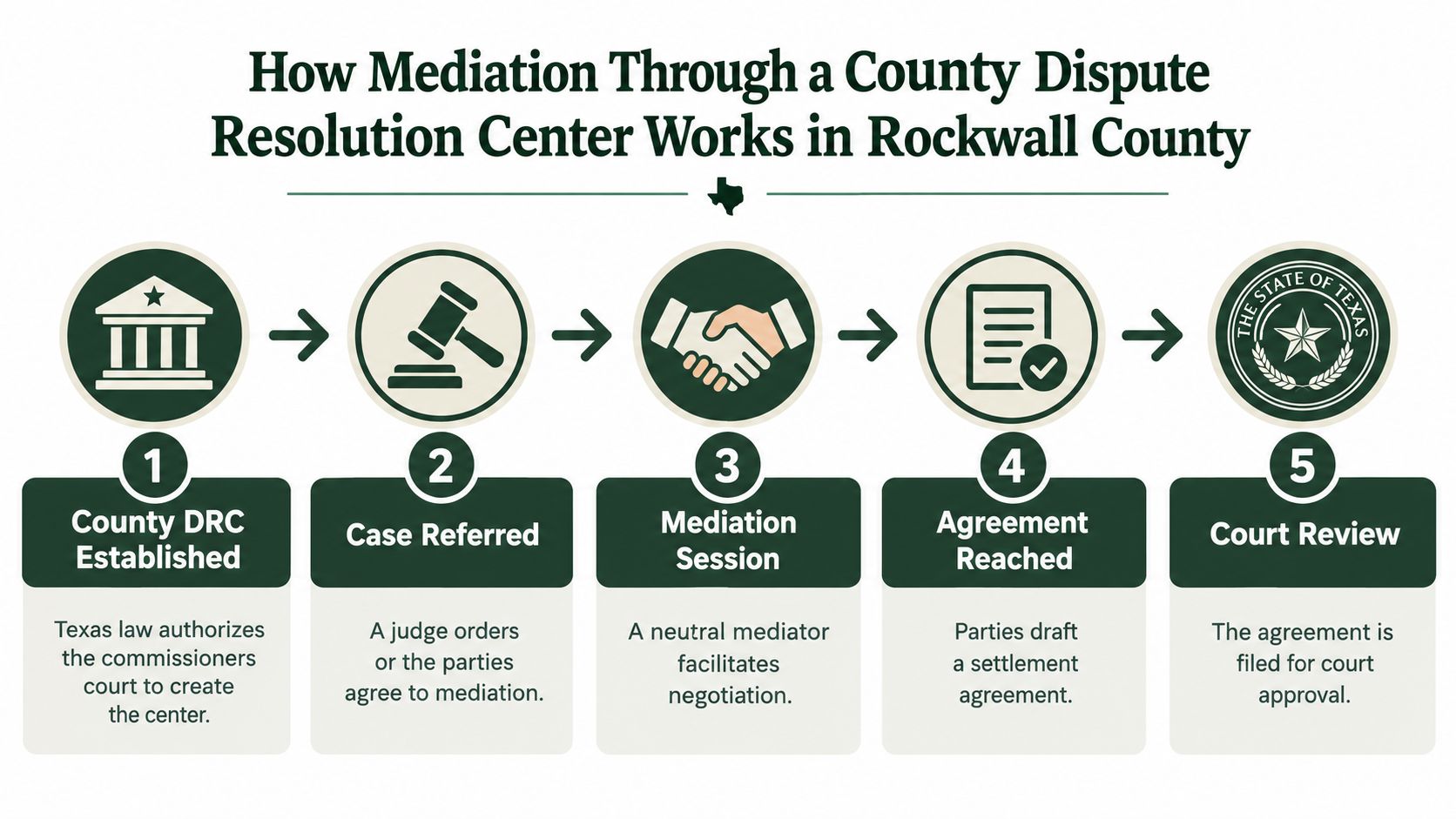
For Rockwall family cases, mediation is usually part of the court path, not a side option people may or may not choose. Families often reach mediation because the judge orders it, the scheduling order points them there, or both sides agree to mediate while the case is pending. If you want the local court expectation in one place, this guide on Rockwall County local rules and mediation before final trial is a useful starting point.
The court setting matters because it changes how families should think about cost. This is less like shopping for a one-time service and more like budgeting for a required step in the case. The question is usually not whether mediation will happen. The better question is which mediation track applies, and what that track charges.
What this looks like in a Rockwall family case
Rockwall County family cases commonly move through the district courts. The 382nd District Court page identifies both the 382nd District Court and 439th District Court as Rockwall County courts, and it describes the 439th District Court as a general jurisdiction trial court that hears civil matters including family law and juvenile cases.
In plain English, the process usually works like this:
- A family case is already on file. This might involve divorce, custody, child support, modification, or enforcement.
- Mediation is set or expected before trial. Sometimes there is a written order. In other cases, the expectation becomes clear during a hearing or scheduling conference.
- The parties arrange the session. A county program, attorneys, or both help set the date and payment details.
- The mediator works with both sides. The mediator is not the judge. The mediator helps the parties discuss options and test possible agreements.
- Any deal is put in writing. If the parties settle, that written agreement can then be carried into the court process.
That sequence is simple on paper. In real life, the details matter.
A court-referred family mediation often comes with deadlines, required attendance, and rules about who must pay up front. If one party lives in Rockwall County but the case is filed somewhere else, or if the parties are looking at a county program outside the filing county, the fee and eligibility questions can change quickly.
After you know the steps, it helps to picture the session itself.
Community disputes and court-referred family disputes are different tracks
County mediation programs may handle both community disputes and court-referred cases, but families should not assume those tracks work the same way.
A community case is often a lower-cost dispute brought to the program outside the pressure of an active family-law trial setting. A court-referred family case usually has more structure. There may be a court deadline, lawyers involved, required paperwork, and a clearer payment schedule.
That difference affects cost because the county program is serving two different kinds of needs. One track focuses on broad public access to mediation. The other is tied more closely to court procedure and the practical reality that family cases often must attempt mediation before trial.
For a Rockwall parent dealing with temporary orders, possession schedules, relocation concerns, or a tense modification case, that distinction is not academic. It helps explain why one person may quote a modest county fee while another reports a much higher mediation bill for what sounds like a similar dispute.
What Determines How Much You Pay for Mediation in Rockwall County
A Rockwall parent may hear, "Mediation only cost my sister a few hundred dollars," then get a quote that is much higher. That gap usually has a simple cause. The two cases were not using the same system.
In Rockwall family cases, cost makes more sense once you start with the court's expectation. Many Texas family courts expect parties to attempt mediation before trial. So the budgeting question is usually not whether mediation will happen, but which kind of mediation will be used and what pricing rules apply to that path.
Local rules shape the price
Texas does not use one statewide mediation fee. County programs often set their own charges under local authority, and private mediators set their own rates. Texas law allows local governments to set reasonable fees for alternative dispute resolution services, as discussed in this Texas Tech ADR training material.
That is why online price comparisons can mislead families. A low number from another county may be accurate there and useless for a Rockwall case.
The main cost drivers
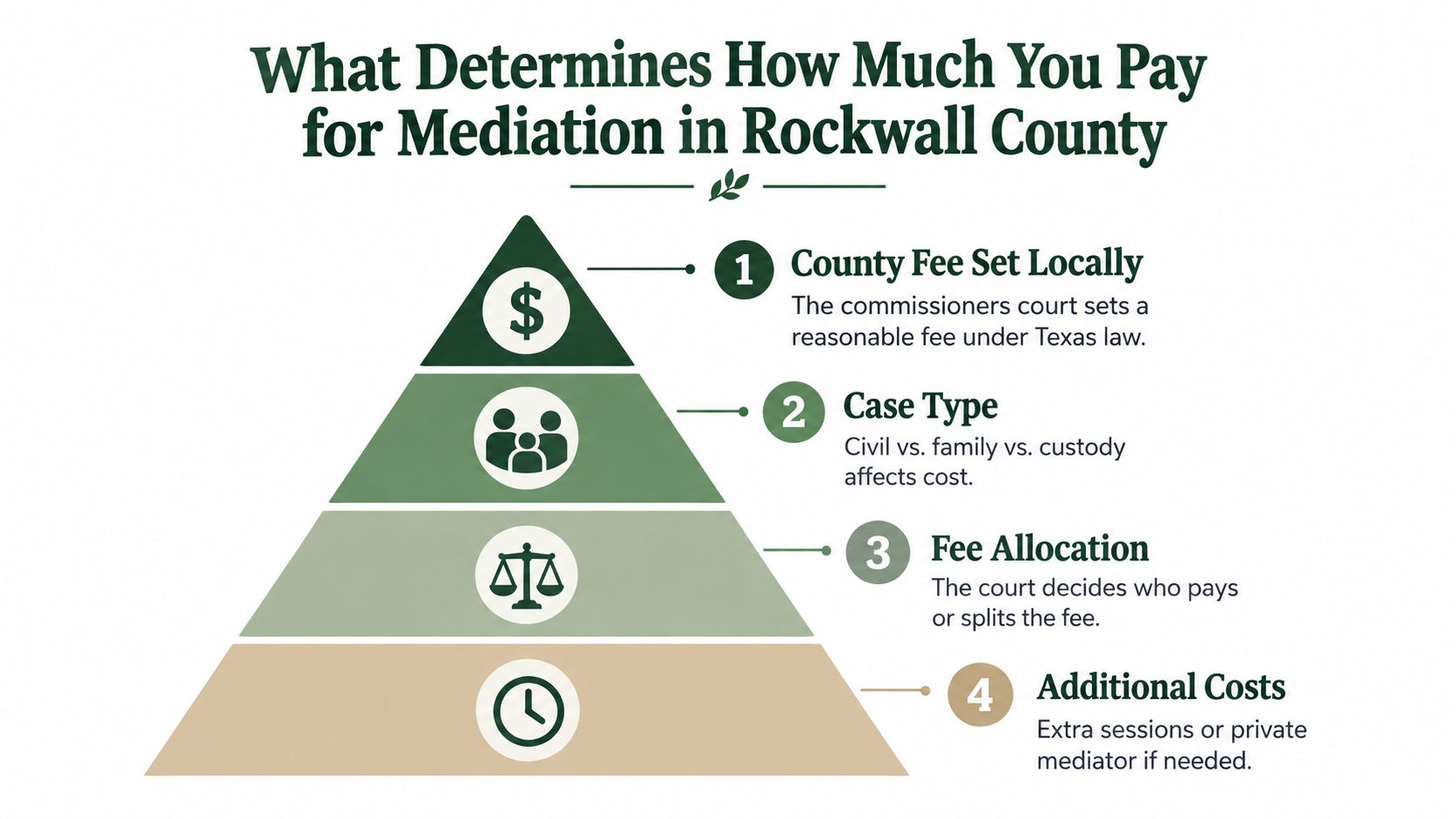
Four questions usually decide what you pay.
- Is the mediation through a county program or a private mediator? County-connected programs often use posted fee schedules. Private mediators usually charge by half day, full day, or hourly time.
- Where is the case filed, and do residency rules matter? Some Texas programs charge more if the case is filed outside the county or if a participant does not live there.
- What type of case is it? Family cases, community disputes, probate matters, and general civil cases may be priced differently.
- Do you qualify for a reduced fee or waiver? Some public programs use income limits or hardship review, while private mediators usually do not.
A useful way to picture this is airline pricing. The seat is still a seat, but the fare changes based on route, timing, and rules. Mediation works much the same way. The session may look similar from the outside, while the actual bill changes because the case fits a different pricing category.
Texas examples show the range
Texas county programs do not all charge alike.
Tarrant County's dispute resolution program lists $120 per party for a half-day district court, county court at law, family, or probate mediation session, plus $30 per party per additional hour. It also lists income-based eligibility and hardship review on the Tarrant County mediation request page.
McLennan County's dispute resolution center lists $325 per party for civil and family or divorce disputes filed in McLennan County and $425 per party for cases filed outside the county. Its FAQ also notes advance payment and possible added charges for overtime, rescheduling, or higher-value disputes on the McLennan County DRC FAQ page.
Those two examples are enough to show the pattern. The label "DRC mediation" does not guarantee a single price. Filing county, case category, and local program rules can move the number quite a bit.
Before you rely on any quote, confirm three things: whether the fee is per party or per case, whether it changes for outside-county filings or nonresidents, and whether extra time can increase the total.
Why Rockwall families get tripped up
Confusion usually starts with a fair assumption. If mediation is often expected before trial, families assume the cost should also be standard. It usually is not.
A Rockwall divorce with property issues may end up in private mediation with a full-day rate. A simpler dispute referred through a county-style program may use a set fee schedule. A family with tight finances may also need to ask one more question early, not late: is there a sliding scale, hardship process, or waiver option?
That is the practical rule. Do not budget from the word "mediation" alone. Budget from the forum, the filing county, the case type, the session length, and any reduced-fee rules that apply to your household.
County Program Mediation Compared With Private Mediation on Cost and Fit
A Rockwall family can end up choosing between two very different lanes. One lane is a court-connected or county-style program with set rules and a more standard fee structure. The other is a private mediator, where the price and process are shaped more by that mediator's practice.
That choice matters because Rockwall courts often expect parties to try mediation before trial in family cases. So the question is usually not whether mediation will happen. The practical question is which setting fits your case and your budget.
Side-by-side comparison
| Factor | County DRC Program | Private Mediator |
|---|---|---|
| Typical pricing structure | Often uses structured per-party fees set locally | Often uses its own fee schedule based on the mediator's practice |
| Cost range | In Texas examples, can run from nominal community-case fees to several hundred dollars per party | A local Rockwall mediator lists full-day mediation at $2,000 per party, and notes that half-day sessions are not offered on the Rockwall mediation fee page |
| Eligibility limits | May include income caps, hardship review, reduced fees, or waivers in some systems | Usually based on the mediator's private rates rather than public eligibility rules |
| Scheduling style | Often tied to court referrals and program availability | May offer more flexibility on timing, pre-mediation preparation, and session format |
| Best fit | Narrower disputes, court-referred matters, or families looking for a more structured public option | Complex property division, high-conflict custody, relocation issues, or cases where parties want a specific neutral |
County-program mediation works a lot like using a published fare instead of chartering your own ride. The route is more standardized. Private mediation gives you more choice, but that flexibility can cost more.
When a county program may make sense
A county-connected option may fit when the dispute is important but contained. Examples include a support modification, an enforcement case with a specific disagreement, or a temporary-orders dispute where both sides need a settlement meeting before the court spends more time on the case.
It can also be the better fit if the court referral points you there, or if your household may qualify for reduced-fee review. For families already weighing other court-related expenses in parenting litigation, it helps to understand possible added costs such as Rockwall County amicus attorney appointment and cost.
When paying more for a private mediator may be reasonable
Private mediation often makes more sense when the case has more moving parts than a standard session can comfortably handle. That can include a divorce with business interests, a disputed characterization of property, a proposed move that affects possession, or a parenting plan with many unresolved details.
In those cases, the higher fee is often buying time, preparation, and subject-matter experience. A private mediator may spend more time reading the file in advance, working through impasse points, and helping draft settlement language that matches the level of conflict in the case.
If you're comparing options, ask your attorney for names in both categories. That can include county-connected options, private neutrals, and, if appropriate, the mediation services offered by The Law Office of Bryan Fagan, PLLC as one available resource in Rockwall family matters.
How to Find Current Rockwall County Fees and Confirm Who Pays
By the time mediation is on the calendar, you don't want guesses. You want the current amount, the payment deadline, and a clear answer on whether the fee is split or assigned in some other way.
A practical checklist you can use
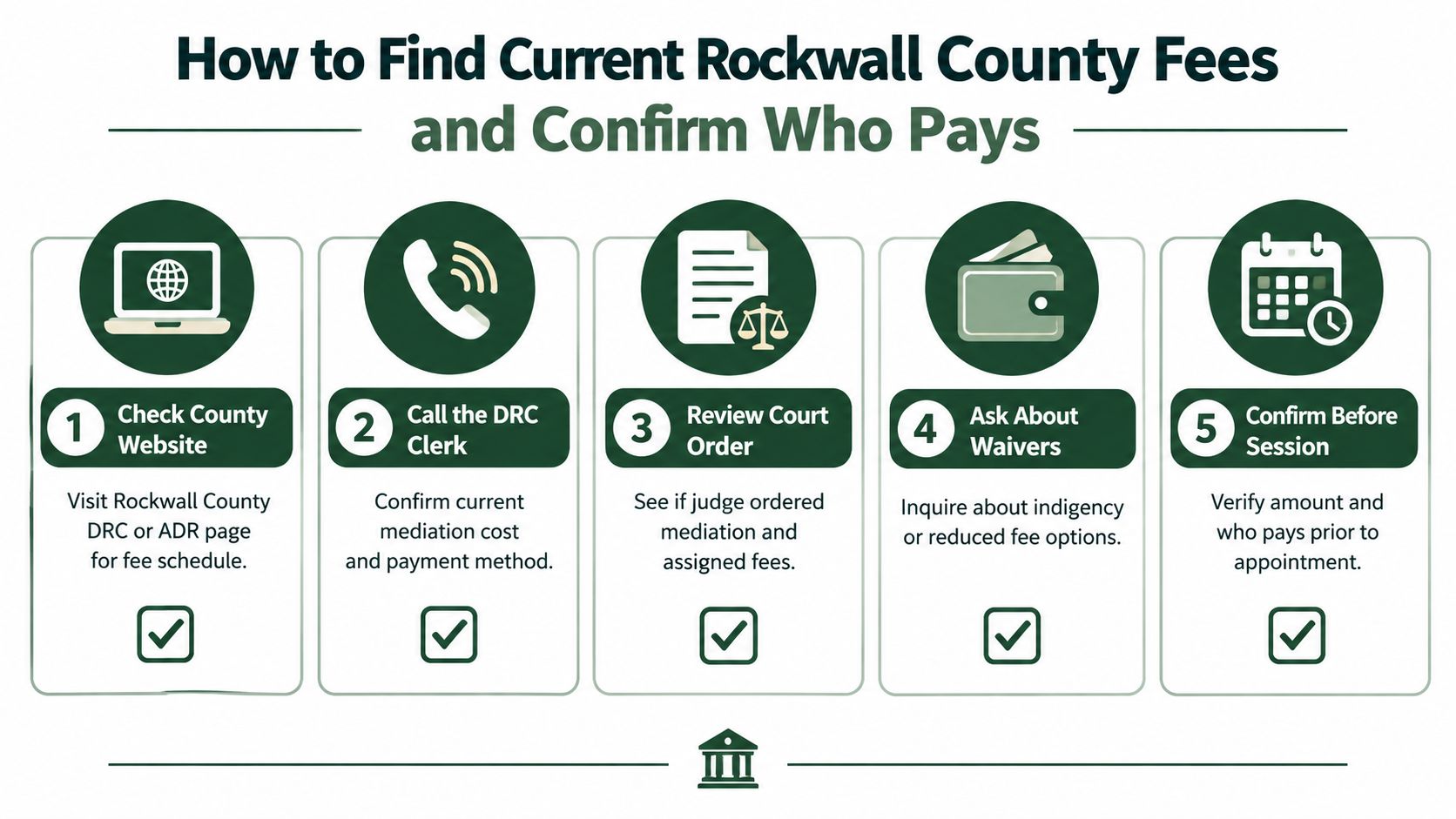
Read the mediation order carefully. If a judge has signed an order, start there. Look for who must attend, whether attorneys attend, how fees are divided, and any deadline for payment or scheduling.
Confirm which office is handling the scheduling. Depending on the case, that may be the court coordinator, a county dispute resolution office, or a private mediator's office.
Ask for the fee quote in writing. You want to know whether the amount is per party or per case, whether the quote covers the entire session, and whether overtime can be added.
Ask what happens if the case resets or someone cancels. Some Texas programs charge additional rescheduling fees or overtime. You don't want to learn that after rearranging work and child care.
Clarify who pays and when. Courts sometimes divide costs evenly, but your order or agreement may say something different.
Questions that save families from last-minute surprises
Bring these questions to your attorney or the scheduling office:
- "Is this a county program or a private mediator?"
- "Is the fee charged to each party separately?"
- "Does filing county affect the amount?"
- "Is advance payment required?"
- "Are there hardship, reduced-fee, or sliding-scale options?"
- "If we need more time, how is overtime billed?"
- "What happens if one party doesn't pay?"
One useful place to cross-check related court costs in the same case is the Rockwall County District Clerk divorce filing fee schedule, because mediation usually appears alongside other case budgeting questions rather than by itself.
Bring your court order, cause number, filing county, and any income information you may need for a hardship request. Those details often determine whether the first quote you hear is actually the quote that applies to you.
What to ask about reduced-fee or hardship options
Some families assume they won't qualify for help and never ask. That's a mistake. Public programs in Texas sometimes use income limits or hardship review. As noted earlier, one county program limits eligibility to participants at or below stated family or individual income levels, or those who can show hardship. That doesn't prove Rockwall uses the same standards, but it tells you the right question to ask locally.
If your divorce, child custody, support, paternity, or protective-order matter is already financially stressful, ask directly whether the program has:
- A reduced-fee schedule
- A hardship application
- Any income-based review
- A policy for reallocating fees by agreement or court order
Two Rockwall County Scenarios That Show Mediation Cost in Practice
These examples aren't predictions. They show how the same word, mediation, can lead to very different budgets.

Scenario one with a court-referred custody and support dispute
A couple in Rockwall is fighting over a modification involving child support, school pickup logistics, and a midweek possession issue. The case is pending locally, and the court requires mediation before trial.
Their first mistake is assuming mediation means a single flat case fee. After checking the order, they learn the mediation is being handled through a court-connected path and that each side needs to confirm payment separately. They also learn the session may carry added cost if it runs long.
The practical lesson isn't the exact amount. It's that a family with a relatively focused dispute still needs to confirm the fee structure, payment deadline, and whether any hardship option exists before the mediation date arrives.
Scenario two with a complex Heath divorce
A spouse in Heath is dealing with a divorce involving substantial property issues, competing views of conservatorship, and a possible relocation disagreement. The family decides a private mediator may be a better fit because the issues need more preparation time and a full day is more realistic.
They find a local Rockwall fee page listing $2,000 per party for full-day mediation and no half-day option. That gives them a concrete planning number, but it doesn't end the budgeting conversation. They still need to ask how preparation, follow-up, and any additional time are handled.
A common budgeting mistake is assuming the other side will pay your share because the dispute feels unfair. Unless the order or agreement says that, don't assume it.
If mediation resolves everything, the case may move forward with settlement paperwork rather than a full trial fight. If it doesn't resolve everything, the parties may still narrow the issues, which can make later hearings more focused.
Next Steps for Rockwall County Families Considering Mediation
If you're planning for Rockwall County dispute resolution center mediation cost, start with one question: Is this a county program matter or a private mediation? That answer usually shapes everything else, including the amount due, whether the fee is per party, whether filing county matters, and whether any hardship option may exist.
A few mistakes show up again and again:
- Waiting too long to budget: By the time a trial setting is approaching, options may be limited.
- Using a number from another county: Texas mediation pricing is often local.
- Ignoring the wording of the court order: The order may answer who pays and when.
- Assuming mediation guarantees settlement: It can help resolve issues, but it doesn't promise a final agreement.
If your case involves divorce, custody, support, enforcement, paternity, protective orders, property division, adoption, CPS issues, or a family-law appeal connected to Rockwall County, gather your paperwork before you make calls. That means your court order, cause number, county of filing, and any financial information you may need if reduced-fee options come up.
For fact-specific questions, it often helps to speak with a lawyer before the mediation date is locked in. That gives you time to discuss process, preparation, payment allocation, and whether the dispute is better suited to a county-connected program or a private neutral.
If you need help sorting out whether your Rockwall family case will go through a county program or a private mediator, The Law Office of Bryan Fagan, PLLC offers guidance on Texas family-law procedure, local court context, and mediation planning. You can learn more or request a consultation through The Law Office of Bryan Fagan, PLLC if you want help evaluating the next step in your Rockwall County case.