
A parent in Heath dies, leaving a will that names his daughter as independent executor. She knows she needs authority to access accounts, handle property, and pay valid debts, but she doesn't know whether she should start with the Rockwall County Clerk, a probate hearing, or an attorney. That uncertainty is common, especially when the family is grieving and the will uses unfamiliar terms.
The Rockwall County independent administration application process generally begins with a formal probate filing, not with immediate control over the estate. The applicant must establish the decedent's identity, death, residence or Texas property, will or heirship information, and the person who should serve as personal representative. After appointment and qualification, the independent executor can handle most estate tasks without ongoing court supervision, but important notice, inventory, and creditor duties still follow.
Table of Contents
- What Independent Administration Means for a Rockwall County Family
- Will-Directed and Court-Created Pathways Under Texas Law
- Confirming Eligibility and Identifying the Right Applicant
- Forms and Documents You Will Need to Prepare
- Filing the Application at the Rockwall County Courthouse
- Post-Appointment Duties, Deadlines, and Bond Issues
- Common Mistakes, Sample Checklist, and Next Steps
What Independent Administration Means for a Rockwall County Family
Independent administration is a Texas probate procedure designed to let an executor or administrator settle an estate with limited ongoing court supervision. The court still has to admit the will when one exists, appoint the personal representative, and issue letters. After that authority is established, the representative can generally manage routine estate business without asking the judge to approve every ordinary transaction. Texas Law Help's probate guidance describes independent administration as a route that may be requested in the will or created by the judge when all beneficiaries agree.
For the Heath daughter in the opening example, this can mean gathering her father's assets, paying valid debts, maintaining or selling estate property, and distributing property under the will without returning to court for each routine step. Dependent administration involves more court involvement in those day-to-day decisions. The right choice depends on the will, the heirs or beneficiaries, the estate's condition, and whether disputes exist.
The practical attraction is straightforward:
- Less routine court oversight: The representative usually has greater flexibility after appointment.
- A clearer path to administration: Texas probate courts commonly use independent administration when its legal requirements are satisfied.
- Fewer repeated approvals: Routine estate actions don't necessarily require separate orders.
- More responsibility outside the courtroom: Less supervision doesn't remove fiduciary duties or deadlines.
Rockwall County families should also understand that “independent” doesn't mean “informal” or “finished.” The applicant still files a formal application, supplies supporting probate information, attends the required proceeding, qualifies after appointment, and completes post-appointment work. The Texas formal administration guide identifies the kinds of information the court needs, including the decedent, property, heirs or beneficiaries, and requested personal representative.

A successful filing gets the representative appointed. A successful administration also includes notices, an inventory or sworn alternative, payment of legitimate obligations, and proper distribution or closing steps. Those later duties are where families often need the most practical guidance.
Will-Directed and Court-Created Pathways Under Texas Law
Texas recognizes two broad ways an estate can proceed independently. The first is will-directed independent administration, where the decedent's will provides for an independent executor or otherwise authorizes independent administration. The second is court-created independent administration, where the will doesn't provide that authority, there is no will, or the named representative cannot or won't serve, and the required distributees consent.
Texas Law Help explains the two basic routes to independent administration, including a provision in the will and creation by a judge when all beneficiaries agree. The court-created route is usually more document-heavy because the application must show agreement among the heirs or distributees, the need for administration, and enough information about assets and debts for the court to act responsibly.
| Feature | Will-Directed (Tex. Est. Code §401.001) | Court-Created (Tex. Est. Code §401.002) |
|---|---|---|
| Starting point | The will authorizes independent administration or names an independent executor | The will is silent, there is no will, or the named representative can't serve |
| Family agreement | The will supplies the authorization | All distributees generally must consent |
| Paperwork concern | The applicant must prove and probate the will | The application must document consent, necessity, and estate information |
| Court role | Appointment and required probate steps remain necessary | The court evaluates whether the requested independent status is appropriate |
| Main risk | Assuming the will's language eliminates all filing duties | Filing without complete heir, asset, debt, or consent information |
The language in a particular will matters. An applicant shouldn't assume that a general appointment as executor automatically resolves every question about independent administration. Before filing in Rockwall County, compare the will's actual wording with the intended application and obtain advice when the language is unclear.
Venue and jurisdiction also matter. A Rockwall mailing address doesn't answer every court question, especially where property, heirs, or a second county are involved. This Rockwall County probate jurisdiction resource can help frame the local court issue, but a fact-specific review may still be necessary.
Practical rule: Choose the pathway first, then build the application around that pathway. Mixing a will-directed filing with court-created consent paperwork can create avoidable delays.
Confirming Eligibility and Identifying the Right Applicant
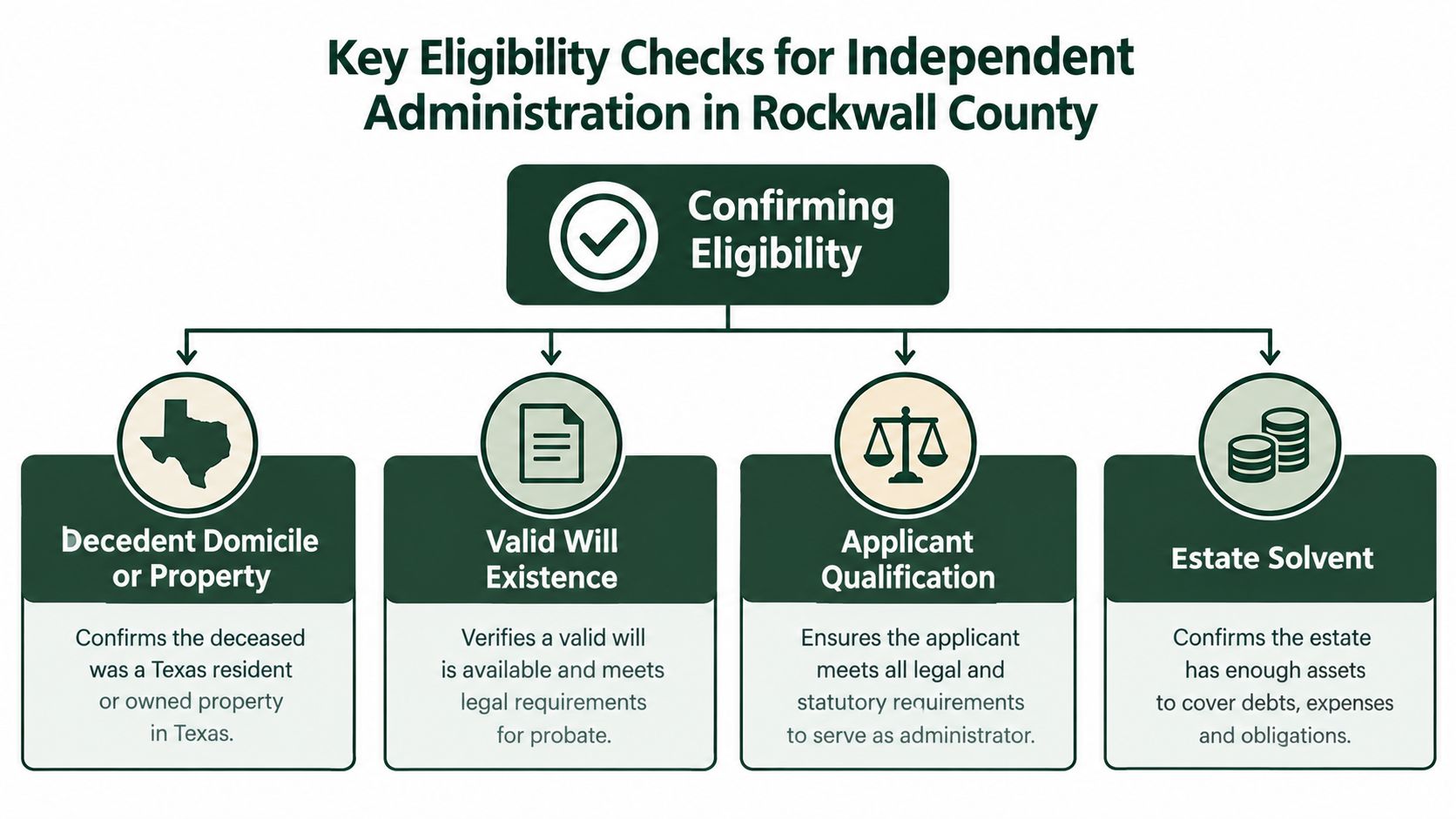
Before anyone prepares a signature page, confirm that Rockwall County is an appropriate place to begin and that the proposed representative is legally suitable. The court needs enough information to determine that administration is necessary and that the applicant has a proper basis to seek appointment.
Four checks to complete before filing
1. Confirm the Texas connection. The decedent may have been domiciled in Texas or may have owned Texas real or personal property at death. A Rockwall County resident will often satisfy this connection, but residence and property records should still be documented rather than assumed.
2. Check the timing and potential objections. Current probate guidance commonly treats 120 hours after death as a threshold relevant to administration, subject to applicable exceptions and fact-specific issues. Also ask whether a will contest, heirship dispute, or other pending disagreement could affect the proposed filing.
3. Identify the appointment route. If there is a will, locate the original and determine whether it names an independent executor and whether that person is willing and qualified to serve. If there is no will, or the named person can't serve, Texas's statutory priority rules may control the appointment analysis.
4. Screen the proposed representative. Texas Estates Code eligibility rules can disqualify an applicant in circumstances such as minority, incapacity, certain felony issues, or non-residence without a required agent. The proposed representative should review those issues before signing an application, oath, or bond-related document.
A Rockwall family should assemble a basic fact sheet containing the decedent's full name, date and place of death, last residence, known real and personal property, debts, and every heir or devisee. Include current addresses and contact details where available. Missing distributee information is one of the problems that can force corrections before a hearing.
For example, if a will names the decedent's daughter but the family knows of a child from an earlier relationship, the daughter shouldn't file based only on the names she recognizes. A complete heir and beneficiary review protects the proceeding from later challenges and gives the court reliable information.
Forms and Documents You Will Need to Prepare
A probate packet works best when the applicant treats it as a coordinated set of documents rather than a single form. The exact filing title can vary with the facts, but the usual starting document is an Application for Probate of Will and Issuance of Letters Testamentary when there is a will. Without a will, the filing may seek administration and Letters of Administration instead.
Prepare the following materials for review:
- The original will and codicils: A copy helps with preparation, but the original document is central to probate when one exists.
- Proof of death: Obtain the death certificate and confirm that names and dates match the application.
- Heir and beneficiary information: List every heir, devisee, and distributee, with reliable contact information.
- Proposed representative information: Identify the person seeking appointment and the requested type of letters.
- Oath of the personal representative: The appointee must complete the required oath after appointment, in the manner required by the court.
- Bond information: Determine whether the will addresses bond and whether a bond-related affidavit, waiver, or proposed order is needed.
- Estate information: Gather deeds, account statements, vehicle records, insurance details, business information, and known debt records.
- Inventory preparation material: Keep a working list of assets, values, liens, and claims so the post-appointment filing can be completed accurately.
- Creditor and claimant details: Preserve statements, notices, invoices, and contact information for people or organizations asserting an estate claim.
Families often remember the will but forget the supporting details. The decedent's Social Security number, death certificate, beneficiary addresses, and information about jointly owned property can become important when identifying accounts or resolving ownership questions. Don't place sensitive information in a filing unless the form or court process requires it, and ask how confidential information should be handled.
Clerk intake is not the same as legal approval. A packet may be returned for missing signatures, defective notarization, inconsistent names, omitted heirs, an absent original will, or a filing problem. Check current Rockwall County filing information before appearing because fees, payment methods, and submission requirements can change.
Filing the Application at the Rockwall County Courthouse
Rockwall County probate filing functions are handled through the Rockwall County Clerk at the Rockwall County Courthouse, 1111 E Yellowjacket Lane, Suite 100, Rockwall, TX 75087, with publicly listed counter contact information at 972-204-6300. Rockwall County courthouse and jurisdiction information identifies that clerk location and also lists local court coverage, including the 382nd District Court, 439th District Court, 503rd District Court, and County Court at Law No. 1.
A practical filing sequence
Confirm the filing office and current submission method. Probate filings generally go through the county clerk's probate intake process, not a family-law filing counter. Ask whether the current matter should be submitted in person, through the available e-filing system, or by another accepted method. Don't decide based only on the mailing city. Communities such as Rowlett and Royse City can cross county lines, so venue depends on the decedent's residence or Texas property facts.
Submit the application and attachments. Include the will when applicable, heir or beneficiary information, proposed order, and requested letters. The clerk's acceptance of a packet means it has been received for processing, not that the judge has appointed anyone.
Pay the current filing charges. The verified information available for this guide doesn't establish a current Rockwall County fee schedule or accepted payment methods. Confirm those details directly with the clerk before filing rather than relying on an old online form.
Track citation and notice. Texas probate procedure commonly includes citation posted for at least 10 days before the hearing. A Texas probate administration guide describes this posting sequence, but the applicant should verify the current docket and clerk instructions for the particular case. Named parties may also need the notice required by the application and the court's process.
Attend the uncontested hearing. After the required notice period, the court may set a short hearing. Bring identification, the original will if it hasn't already been accepted, filed copies, proposed orders, and any documents needed to answer the judge's questions.

The Rockwall County courthouse resource comparing local courthouse locations may help prevent a simple location mistake. If the clerk rejects an e-file or returns an in-person packet, read the rejection reason carefully. Correct the stated defect, preserve the original filing information, and resubmit according to the clerk's instructions.
The court's order appointing the representative isn't the same as qualification. Letters Testamentary or Letters of Administration generally issue after the appointment steps are complete, and the representative may need to sign an oath within 20 days when required. A Texas independent administration guide discusses the hearing, letters, oath, bond, inventory, and creditor notice sequence.
Post-Appointment Duties, Deadlines, and Bond Issues
The most common misunderstanding is that the estate is complete when the judge signs the appointment order. The order starts the representative's working phase. The independent executor must still qualify, obtain authority through the letters, protect estate property, provide required notices, and prepare the inventory or sworn alternative.
The early timeline
After appointment: Complete the oath and any required qualification steps. A bond may be unnecessary when the will waives it, but the court can require a bond in appropriate circumstances. If the will is silent or the order requires security, don't assume the representative can act before the bond issue is resolved.
After letters issue: Begin identifying and securing estate property, reviewing debts, and organizing beneficiary information. Independent authority reduces routine court applications, but it doesn't eliminate the duty to act loyally, prudently, and according to the will or applicable Texas law.
Within 30 days for creditor notice: Practice guidance commonly identifies a 30-day period after receiving letters for publishing notice to creditors. The Texas independent administration guide cited above discusses this fast post-appointment responsibility. Confirm the exact notice required for the estate and keep proof of publication or delivery.
Within 90 days: Prepare and file an inventory, appraisement, and list of claims, or a sworn alternative when permitted. Texas Law Help's probate court basics identifies the inventory or affidavit-in-lieu requirement and the 90-day period after qualification described in Texas probate guidance.
During administration: Pay legitimate expenses and claims, manage property, maintain records, and communicate appropriately with interested parties. If disputes arise, court involvement may become necessary even though the administration began independently.
Bond protects the estate against certain risks, but the requirement depends on the will, the court's order, and the circumstances. A surety can involve cost and application requirements. The representative should also avoid treating estate money as personal money, making undocumented distributions, or selling property without understanding title, debt, tax, and beneficiary consequences.
The appointment grants responsibility, not a blank check. Independent executors still answer for mishandling estate assets and missing required duties.
Annual accountings and closing requirements can depend on the estate's status, court orders, and unresolved claims. Don't treat a “90-day inventory” as the only deadline. Use the letters' issuance date and qualification date to build a written calendar, and obtain advice promptly if a deadline has already passed.
Common Mistakes, Sample Checklist, and Next Steps
A Rockwall family can lose time before the hearing by assuming the courthouse will handle every procedural detail. For example, an applicant may forget that citation must be posted for the required period, then arrive expecting the judge to hear the application immediately. The result can be a rescheduled setting or a request for corrective action.
Another family may calculate creditor-related timing from the date of death instead of the date letters were received. A third may see no bond language in the will and assume no bond can ever be required, even though the court's order and the circumstances still matter. These mistakes can delay authority or expose the representative and estate to avoidable problems.
A working checklist
- Eligibility: Confirm Texas residence or Texas property, death information, the will or heirship facts, and the proposed applicant.
- Documents: Assemble the original will and codicils, death certificate, heir and beneficiary contacts, oath materials, bond information, and estate records.
- Filing: Confirm the Rockwall County Clerk's current intake method, fees, payment options, and requested letters.
- Notice: Track citation posting and every notice requirement from the filing.
- Hearing: Bring the original documents, identification, proposed orders, and corrected copies.
- Qualification: Complete the oath, address bond requirements, and obtain letters before acting for the estate.
- Post-appointment: Calendar creditor notice and the 90-day inventory or sworn alternative deadline using the qualification date, as explained in the Texas probate practice overview.
Minor children, missing heirs, real property in multiple counties, or creditor disputes can change the analysis. A family facing any of those issues should discuss the facts with a qualified probate attorney before signing the application or distributing property.
The Law Office of Bryan Fagan, PLLC offers Rockwall County families guidance with probate applications, independent administration, heir and beneficiary issues, and post-appointment compliance. If you need help reviewing the will, preparing the filing, or planning the next steps after appointment, visit The Law Office of Bryan Fagan, PLLC to learn about arranging a consultation.