
In Texas, a marriage ceremony generally cannot take place until 72 hours after the marriage license is issued, and the license is valid for 90 days from issuance, unless a statutory exception, such as a qualifying premarital education certificate or judicial waiver, applies. The key date is issuance, not the day you submit the application.
A couple in Rockwall or Heath might pick up a license on Wednesday, book a Friday ceremony, and assume the timing works. The first question is simple: when did the County Clerk issue the license, and what exact time will 72 hours have passed? That answer controls whether the ceremony can legally occur. The same license also has an expiration deadline, so postponing the ceremony creates a second timing issue.
The rules apply to couples throughout Rockwall County, including Rockwall, Heath, Fate, Royse City, McLendon-Chisholm, and other communities. This guide explains the waiting period, statutory exceptions, Rockwall County application considerations, and a single timeline that connects the 72-hour hold with the license's 90-day validity window.
Table of Contents
- Why Your Ceremony Date Depends on the 72 Hour Rule
- What the 72 Hour Waiting Period Actually Means
- Who Can Skip the Waiting Period
- How to Get a Waiver or a Premarital Education Certificate
- Applying for a Marriage License in Rockwall County
- Planning Your Timeline From Issuance to the 90 Day Expiration
- Your Pre-Wedding Checklist and Next Steps
Why Your Ceremony Date Depends on the 72 Hour Rule
Suppose a couple from Rockwall obtains a marriage license on Wednesday and wants to marry on Friday evening. Whether Friday works depends on the issuance time. The ceremony must wait until 72 hours have passed after issuance, so a Friday ceremony could be too early if the license was issued late on Wednesday.
The same answer applies to a couple in Heath, Fate, or Royse City. Applying for the license and receiving the issued license aren't necessarily the same milestone for timing purposes. Under the Rockwall County marriage-license information, the waiting period runs from issuance.
Practical rule: Don't schedule the ceremony from the application date. Schedule it from the license issuance date and time.
A qualifying exception may change the result. Texas recognizes exceptions for certain military applicants, certain Department of Defense employees or contractors, judicial waivers for good cause, and couples who complete a qualifying premarital education course and provide the required certificate. Those exceptions aren't automatic just because a couple has a tight wedding schedule.
Rockwall County couples should also keep the second deadline in view. The license is valid for 90 days after issuance, so a ceremony must fit between the end of the waiting period and the expiration date. A venue change, travel problem, or officiant conflict can matter if the new ceremony date approaches the end of that window.
Before visiting the County Clerk, confirm current office requirements and decide whether you may qualify for an exception. If you need a judicial waiver, don't treat that request as a last-minute scheduling fix. It involves a separate legal question about whether good cause exists.
What the 72 Hour Waiting Period Actually Means
Texas Family Code Section 2.204 establishes a default waiting period between license issuance and the marriage ceremony. The Texas State Law Library's marriage-law reference explains that the rule has statutory exceptions and can carry a serious legal consequence if a ceremony occurs in violation of the waiting period.
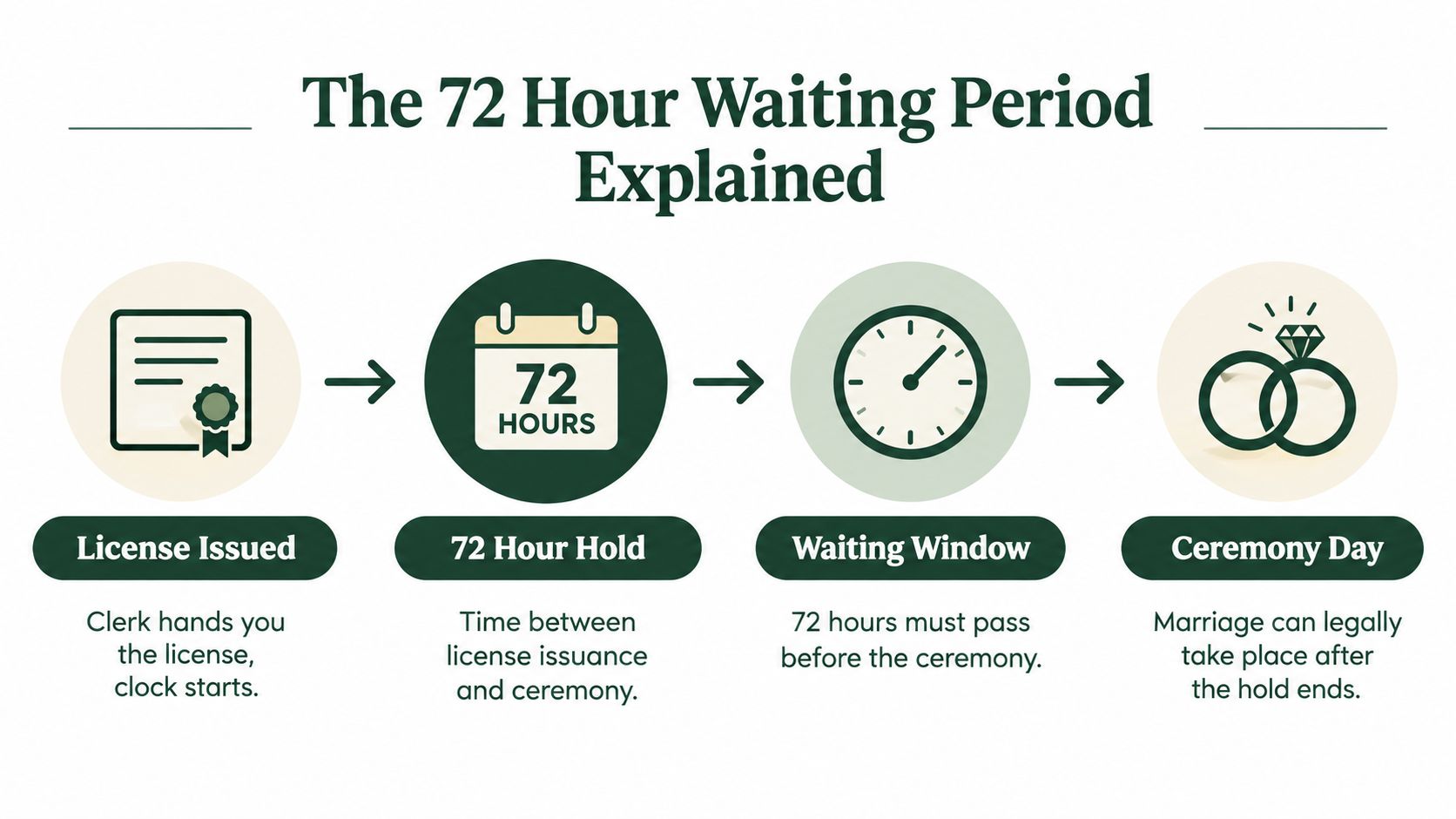
Think of the rule as a legally required hold. The County Clerk issues the document, but the couple still has to let the waiting window run before the ceremony can occur. The clock doesn't begin when you start an online form, make an appointment, or arrive at the courthouse. It begins when the license is issued.
Issuance starts the clock
For example, if the County Clerk issues a license on Monday morning, the couple generally reaches the earliest ceremony point after 72 hours, which is the 73rd hour after issuance. If the license isn't issued until Monday afternoon, the relevant time shifts accordingly.
That distinction can affect a Friday wedding, a venue reservation, or an officiant's travel plans. A couple should record the issuance date and preserve the license paperwork rather than relying on memory.
Why the rule matters
The waiting period isn't merely a suggestion or a courtesy delay. Under Texas Family Code Section 6.110, a court may grant an annulment when a ceremony occurred in violation of the waiting-period requirement. The Texas Family Code text describing the 72-hour rule identifies the hold as a legal condition unless an enumerated exception applies.
That doesn't mean every timing mistake produces the same result, and it doesn't replace fact-specific legal advice. It does mean couples should treat the date and documentation seriously. If the ceremony already occurred too early, speak with a qualified Texas family-law attorney promptly rather than assuming the marriage record will resolve the issue by itself.
Who Can Skip the Waiting Period
A couple planning a Friday ceremony in Rockwall County may have two separate timing questions: whether the 72-hour waiting period applies and how long the issued license remains valid. An exception can remove the waiting hold, but it does not extend the license's 90-day validity window. The ceremony must still occur before the license expires.
Texas law lists narrow categories of applicants who may marry without waiting the full period when the required facts and documents are established. The Texas statutory overview of the waiting-period exceptions identifies these paths:
- Active-duty military applicants: An applicant serving on active duty in the United States military may qualify. A Royse City service member preparing for deployment may need documentation confirming active-duty status.
- Certain Department of Defense workers: Some Department of Defense employees or contractors fall within an exception. A general connection to federal work is not enough. The person's employment or contract must fit the statutory category.
- Judicial waiver for good cause: A qualified judge may issue a written waiver when good cause supports it. A wedding date, travel plan, or venue reservation may explain the request, but inconvenience alone does not guarantee approval.
- Qualifying premarital education: A couple may avoid the waiting period by completing a qualifying course and filing a completion certificate issued within one year before the license application (Texas statutory overview of the waiting-period exceptions). The certificate must satisfy the applicable requirements and be available when the couple applies.
Documentation controls the result
The exception depends on proof, not just on a couple's description of the situation. A military applicant should ask which service records the issuing office accepts. A Department of Defense employee or contractor should confirm that the employment relationship matches the statutory language. A couple using premarital education should check the certificate date and bring the certificate to the application appointment.
A judicial waiver follows a separate route. The County Clerk issues marriage licenses, while a judge must provide the written waiver. Asking the Clerk to remove the hold is not the same as obtaining judicial approval.

Identify the exception before choosing the ceremony date. If the facts do not clearly fit one category, build the ordinary waiting period into the schedule and confirm the paperwork with the appropriate Rockwall County office or a qualified attorney.
How to Get a Waiver or a Premarital Education Certificate
The premarital education route usually starts before the license application. Complete a qualifying course, obtain the completion certificate, and present it when applying. The certificate must have been issued within one year before the license application, not merely before the wedding.
A Fate couple with a venue booked for a date soon after the license application might choose this path if they have enough time to complete the course and receive the certificate. They should confirm that the course qualifies and that the certificate contains the information the County Clerk needs before relying on it.

A judicial waiver follows a different path. A qualified judge may waive the waiting period for good cause, but the couple must request that relief and obtain the required written waiver. The process may involve identifying the appropriate court, presenting the reason for the request, and supplying documents that support the facts. Current local procedures can change, so confirm them with the appropriate Rockwall County court or clerk before appearing.
A practical preparation list
- Explain the timing problem: State when the license will be issued, when the ceremony is planned, and why the ordinary waiting period creates a genuine problem.
- Bring supporting records: Gather documents that support military status, Department of Defense employment, course completion, or the circumstances offered as good cause.
- Confirm the issuing authority: A marriage-license question belongs with the County Clerk, while a judicial waiver involves a qualified judge and court-related procedures.
- Keep the written result: If a waiver is granted, retain the signed documentation and confirm how it should be presented when the license is used.
Couples with unusual facts should get individualized guidance rather than relying on a general checklist. The Rockwall County law library and self-represented family forms resource may help readers locate general legal-information materials, but it isn't a substitute for legal advice about a waiver request.
Applying for a Marriage License in Rockwall County
The Rockwall County Clerk handles marriage licenses. That office is separate from the District Clerk and the courts that handle family-law matters such as divorce, custody, support, and judicial requests. Knowing that distinction can prevent a couple from going to the wrong office when a waiver or other court-related issue arises.
Requirements can change, so confirm current instructions directly with the County Clerk before visiting. Couples should ask about identification, application procedures, accepted payment methods, current fees, office hours, and whether any appointment or local scheduling practice applies.
What to prepare
Bring government-issued identification for both applicants and the information needed to complete the application. The application commonly requires personal details such as names, ages, and Social Security information. If a prior marriage or another legal issue creates uncertainty, ask the Clerk what documentation is required rather than assuming a particular record will be sufficient.
Both applicants generally appear together to apply. The County Clerk can confirm whether a specific circumstance permits an alternative arrangement.
A fee is due at application, and the amount can vary. Couples should verify the current fee directly instead of relying on an old website, a wedding vendor, or an online article. A qualifying premarital education certificate may affect the applicable fee or waiting-period process, so mention it when you contact the office.
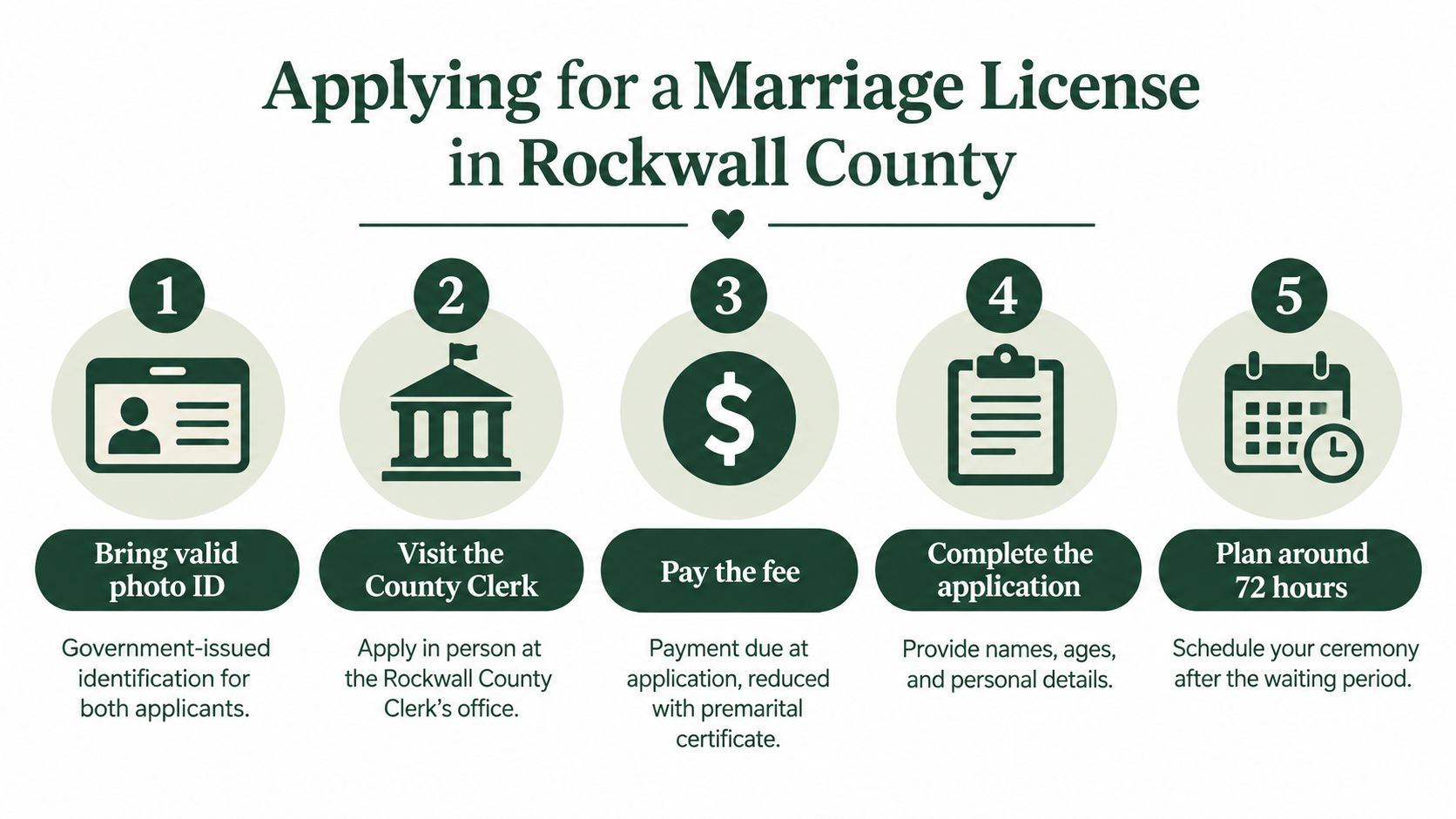
After the license is issued, write down the issuance date and time. Don't use the date you first contacted the office as the starting point for the ceremony calculation.
The Rockwall County courthouse family-hearing guide can help distinguish courthouse resources from the County Clerk's marriage-license function. That distinction is especially useful when a couple is also dealing with an active divorce, custody, or other family-law matter.
Planning Your Timeline From Issuance to the 90 Day Expiration
The two deadlines work like bookends. The ceremony generally can't happen until the 73rd hour after issuance, but the license also expires 90 days after issuance. The legal ceremony date must fall inside that usable window unless an exception changes the waiting-period side of the timeline.
| License Issued | Earliest Ceremony | 90-Day Expiration | Watch-Out |
|---|---|---|---|
| Monday morning | Thursday morning after 72 hours have passed | 90 days after that Monday issuance date | Confirm the issuance time, not just the weekday |
| Wednesday afternoon | Saturday afternoon after 72 hours have passed | 90 days after that Wednesday issuance date | A Friday ceremony may be too early |
| Near the planned venue date | The 73rd hour after issuance, unless an exception applies | 90 days after issuance | Leave room for a reschedule before expiration |
The table shows why a Monday license can generally support a Thursday ceremony, while a Wednesday license may not support a Friday ceremony. The exact earliest time depends on when the license was issued. A clerk's office visit earlier in the day doesn't help if the license wasn't issued until later.
Keep the expiration date visible
The 90-day validity window creates a different risk. A couple may clear the waiting period, then postpone because of weather, travel, illness, venue problems, or an officiant conflict. If the replacement date falls after expiration, the couple may need to apply again and pay again.
Don't wait until the last available date to discover that the venue or officiant isn't available. Put both milestones on the shared calendar:
- The exact issuance date and time.
- The earliest lawful ceremony time.
- The 90-day expiration date.
- A backup ceremony date that remains within the valid window.
If a ceremony must be rescheduled, contact the Rockwall County Clerk promptly and ask what the current office requires. Don't assume the original license can be extended, amended, or reused after expiration. The Rockwall County reset and continuance resource addresses court scheduling rather than marriage-license expiration, but it illustrates why a changed date should be handled directly with the office responsible for the applicable rule.
Your Pre-Wedding Checklist and Next Steps
Use this checklist before you finalize the ceremony date:
- Confirm current requirements: Contact the Rockwall County Clerk about identification, application details, fees, hours, and any local instructions.
- Choose the timing path: Decide whether you'll follow the ordinary waiting period, use a qualifying premarital education certificate, or seek a judicial waiver.
- Record issuance precisely: Write down when the license is issued, because that starts the waiting-period clock.
- Calendar both deadlines: Mark the earliest ceremony time and the 90-day expiration date.
- Check the officiant: Confirm that the officiant can perform the ceremony within the license's valid window.
- Plan for changes: Keep a backup date before expiration in case the venue, travel plans, or officiant changes.
This process is usually straightforward, but a prior divorce, unresolved name-change issue, custody concern, or another family-law matter can create questions outside the license application itself. Couples in Rockwall, Heath, Fate, Royse City, McLendon-Chisholm, and nearby communities can benefit from fact-specific guidance when those issues overlap.
The Law Office of Bryan Fagan, PLLC offers family-law guidance for Rockwall County residents whose marriage plans intersect with divorce, custody, support, paternity, or other legal concerns. Visit The Law Office of Bryan Fagan, PLLC to learn about the Rockwall office and request a consultation about your circumstances.